Scene 1
The Day of Inking
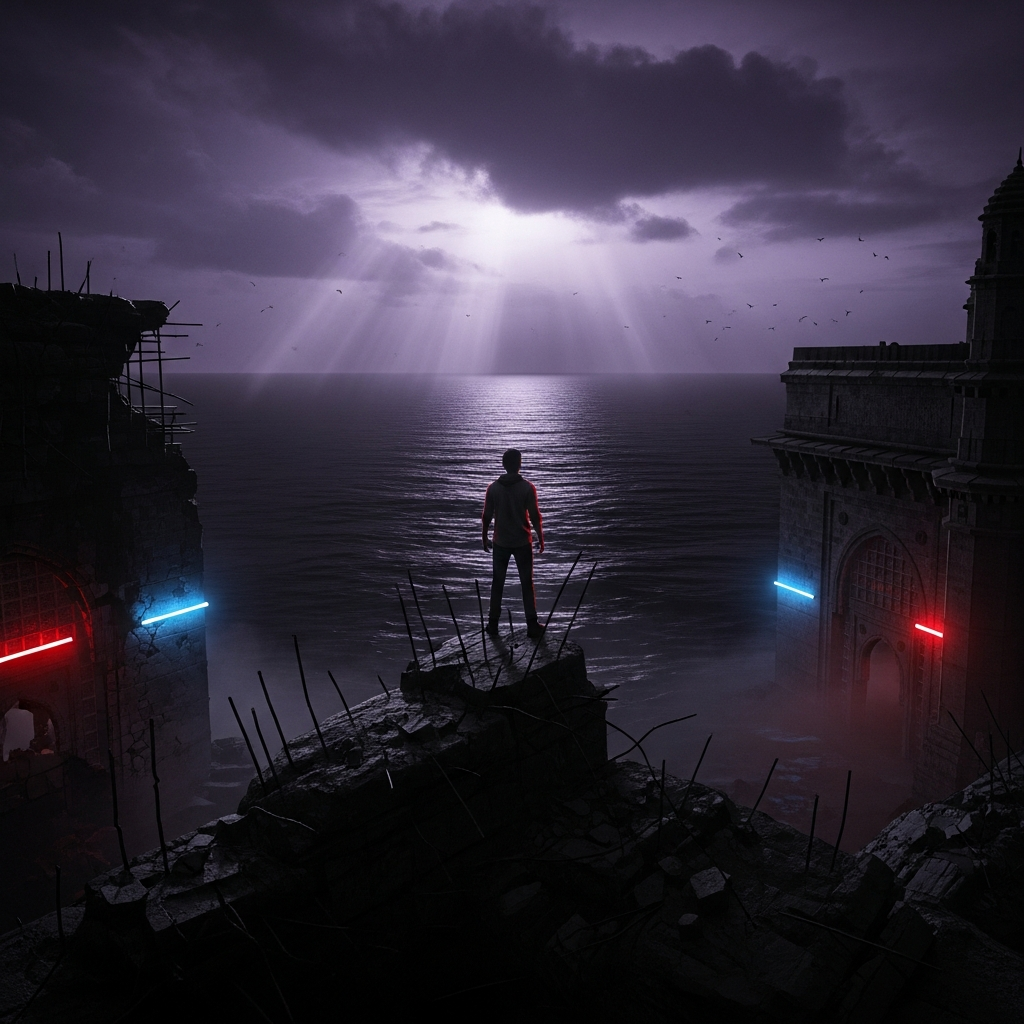
The horizon did not bleed red that evening; it bruised into a suffocating, oily violet before the tides finally curdled into pitch. Adesh Ingale stood upon the jagged remains of the Gateway of India, his boots slick with a substance that was no longer water. It was the Great Darkening. Within hours, the Arabian Sea had transformed into a viscous, obsidian soup that swallowed the light of the moon. Adesh watched in silent horror as the phosphorescence of the waves died, replaced by a heavy, rhythmic thrumming that vibrated in his very marrow. The air grew thick with the scent of ozone and rotting kelp, a metallic tang that coated the back of his throat. He remembered the blue—the vibrant, dancing azure of his childhood—but as he reached down to touch the surface, the liquid clung to his glove like living shadow, cold and hungry. People screamed in the distance, fleeing the encroaching slick that began to climb the stairs of the city, but Adesh remained rooted. He saw the first of the deep-sea leviathans breach the surface, not to hunt, but to die, their silver scales tarnished by the encroaching void. In that moment, Adesh Ingale realized the world had not just changed; it had been overwritten by a darkness that defied biology. He tightened the straps of his pack, the weight of his father’s old navigational charts pressing against his spine. The age of blue was over, and the era of the abyss had begun. He would need to find the source of the rot if he were to ever see a reflection in the waves again.
Scene 2
The Scavenger’s Silence
Ten years of obsidian silence had turned Adesh Ingale into a ghost among ruins. He moved through the skeleton of a coastal refinery, his movements practiced and economical to conserve the precious oxygen in his scavenged tanks. The ‘Black,’ as the survivors called the ocean, had become a sentient wall of sludge that had swallowed the lowlands, turning cities into salt-crusted labyrinths. Adesh used a long-handled probe to test the viscosity of the pools forming in the rusted corridors. His fingers, calloused and stained with permanent soot, adjusted the dials on his Geiger counter. It wasn’t radiation he feared, but the ‘Siren’s Hum’—the low-frequency vibration emitted by the black water that drove men to walk into the surf and never return. He found what he was looking for in the belly of the refinery: a pressurized core capable of withstanding the crushing depths of the midnight zones. As he worked to decouple the unit, his ears caught the wet, slithering sound of something moving in the shadows. The Black had birthed its own children, eyeless horrors that thrived in the absence of light. Adesh didn’t reach for a gun; he reached for a flare. The searing magnesium light revealed a creature of translucent skin and obsidian veins, recoiling from the artificial sun. Adesh’s heart hammered against his ribs like a trapped bird, but his hands remained steady. He had survived the collapse of the biosphere by learning the language of the dark, and he would not let a nightmare stop his progress. He dragged the heavy core toward his skiff, the sound of metal on stone echoing like a funeral knell.
Scene 3
The Chart of the Abyss
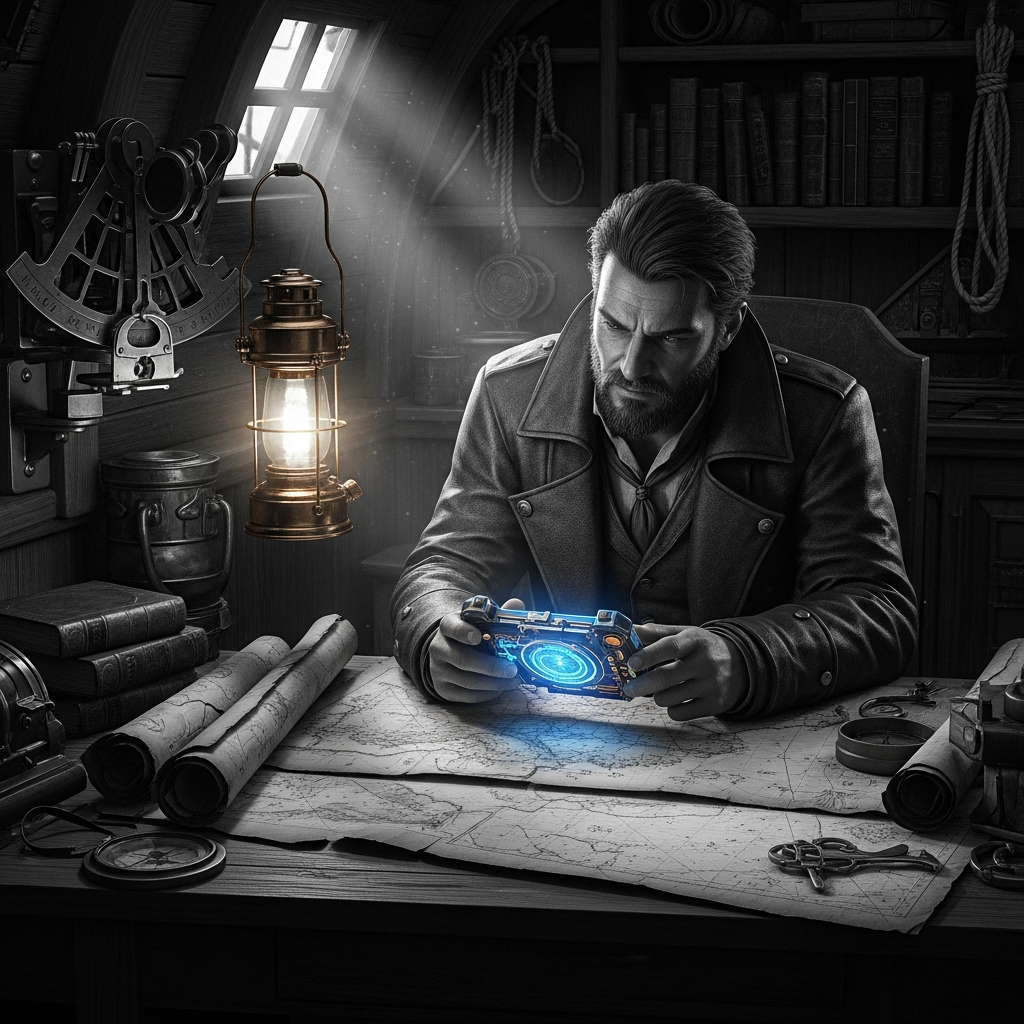
Inside the cramped, candle-lit cabin of his fortified trawler, Adesh Ingale unrolled the vellum maps that had become his obsession. These weren’t standard nautical charts; they were composite overlays of satellite data from before the Darkening and sensory readings he had spent years collecting. His fingers traced a path toward the Mariana Trench, where the seismic readings suggested a massive, pulsating heart of darkness was anchored. The Black wasn’t just pollution; it was a geothermic eruption of ancient, prebiotic sludge that had been locked away for eons, now triggered by human greed. Adesh’s eyes, bloodshot from lack of sleep, focused on a specific coordinate: The Pulse Point. He believed that if he could trigger a massive electrolytic reaction at the source, he could force the Black to coagulate and sink, allowing the natural currents to begin the slow process of filtration. It was a suicide mission, a one-way trip into the crushing pressure of the deep, but the alternative was watching the last of humanity wither into shadows. He looked at a faded photograph of his daughter, her smile a memory from a world of color. The scent of salt and rot was omnipresent, leaking through the seals of his windows. He began to calibrate the ‘Prism of Aeons,’ a device he’d built from salvaged laboratory equipment. It was his only weapon against the chemical tide. As the storm outside lashed the hull with ink-like rain, Adesh Ingale made his choice. He would descend into the throat of the world and either bring back the blue or be consumed by the midnight he fought so hard to escape.
Scene 4
The Iron Descent
Visual Synchronization Offline
The ‘Nautilus-X’ was a coffin of steel and hope, and Adesh Ingale was its only occupant. As the crane lowered him into the churning, oily waves, the light of the surface world vanished with terrifying speed. At five hundred meters, the darkness became absolute, pressing against the reinforced portholes with the weight of a thousand sins. Adesh watched the depth gauge climb—one thousand, two thousand, five thousand meters. The external lights of the submersible struggled to pierce more than a few feet of the viscous liquid, revealing only passing drifts of ‘sea snow’ that looked like falling ash. The internal temperature of the sub dropped, and Adesh could see his breath frosting on the glass. He felt the immense solitude of the abyss, a place where time and space seemed to liquefy. Suddenly, the hull groaned, a scream of protesting metal that vibrated through Adesh’s boots. Something large, something immense, was brushing against the sub. He saw a massive, lidless eye pass by the porthole, a pale yellow orb the size of a car, swirling with the same black ichor that filled the sea. Adesh held his breath, his hand hovering over the emergency ballast release. The creature didn’t attack; it seemed to recognize him as a fellow traveler in the void. It drifted away, leaving Adesh alone with the hum of his oxygen scrubbers. He was entering the Hadal zone, the deepest trenches of the earth, where the pressure was enough to turn bone to powder. He whispered a silent prayer to a God he hadn’t spoken to in a decade, his eyes locked on the sonar ping that marked the heart of the rot.
Scene 5
The Obelisk of Silt
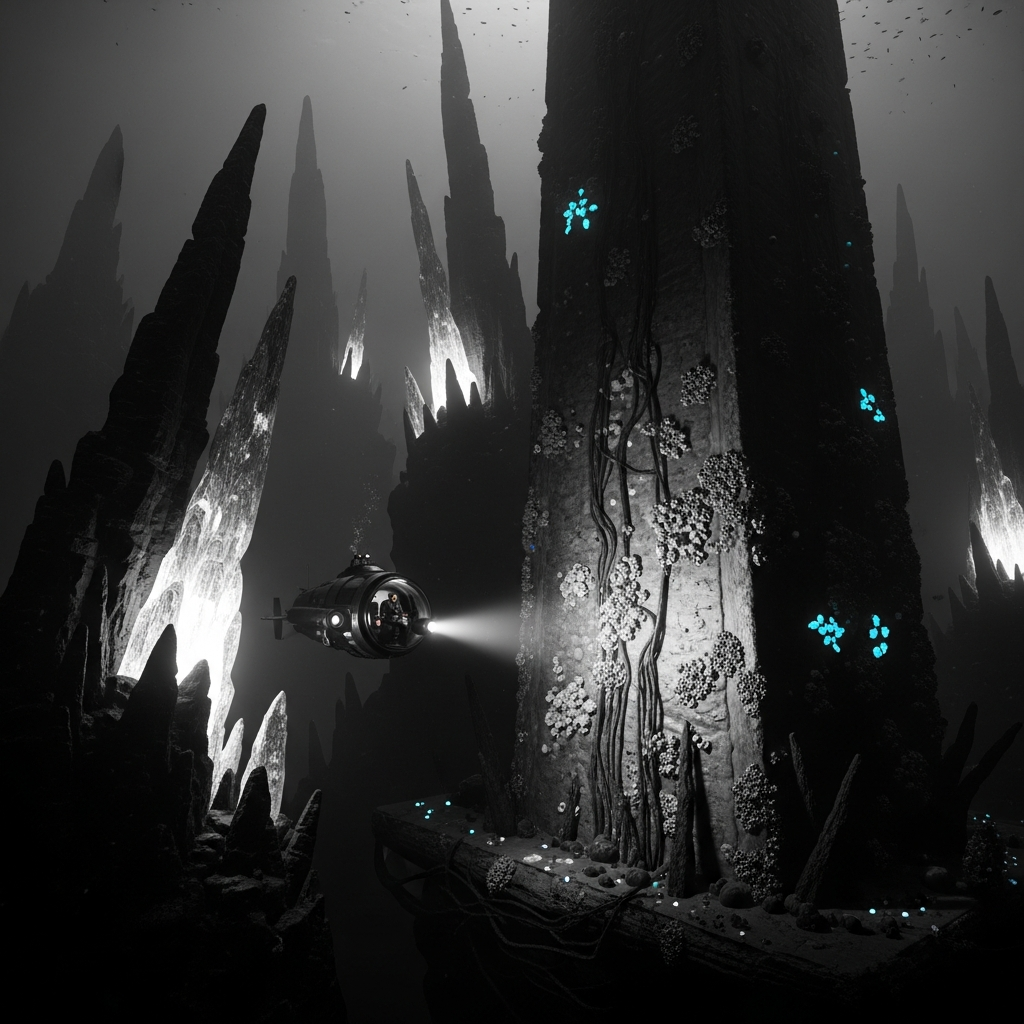
The floor of the trench was not sand, but a forest of crystalline spires that pulsed with a sickly, rhythmic light. In the center stood the Obelisk of Silt, a towering structure of organic matter and ancient minerals that looked like a jagged tooth rising from the earth’s jaw. This was the source—a biological vent that was pumping millions of gallons of the Black into the global currents every hour. Adesh Ingale steered his sub into the shadows of the spires, the proximity to the Obelisk causing his instruments to haywire. The water here was hot, shimmering with thermal energy that threatened to melt his hull. He could hear it now, the ‘Siren’s Hum,’ no longer a vibration but a physical presence that clawed at his mind, urging him to open the hatch and embrace the dark. Adesh gritted his teeth, the sweat stinging his eyes as he fought the mental intrusion. He saw the bodies of creatures fused to the Obelisk, their forms twisted into grotesque shapes of eternal agony. The Black was a hive mind, a primordial soup that wanted to reclaim the world for the era of anaerobic life. Adesh deployed the sub’s mechanical arms, clutching the Prism of Aeons. He had to place it perfectly within the central vent of the Obelisk. One mistake would trigger a pressure collapse that would vaporize him instantly. He moved with the precision of a surgeon, his mind focused on a single image: the sun hitting the water of a clear mountain lake. The Obelisk seemed to sense his intent, the crystalline spires glowing brighter, sending out ripples of kinetic energy that tossed the sub like a toy.
Scene 6
The Sacrifice of Will
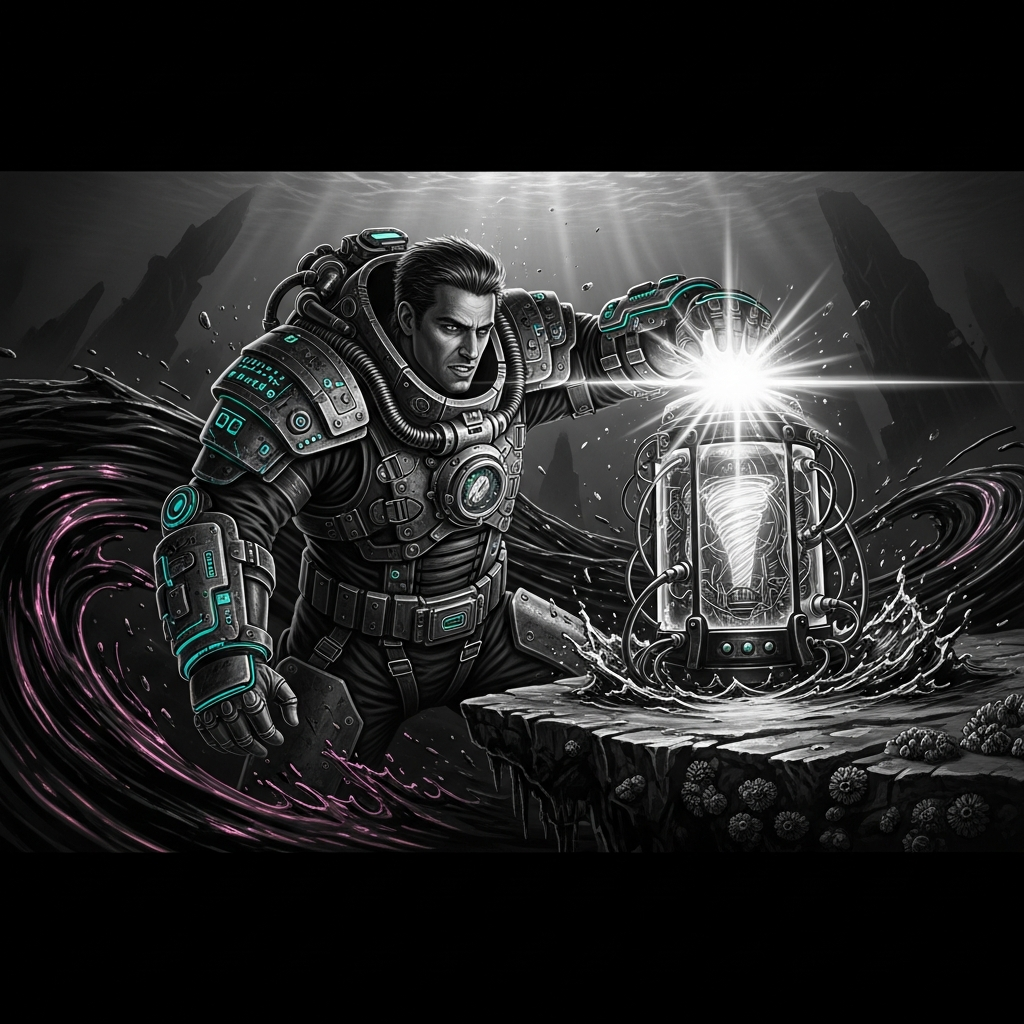
The Prism was in place, but the trigger mechanism had been damaged during the descent. Adesh Ingale looked at the sparking wires and the fading power levels on his console. There was only one way to complete the circuit: he had to leave the sub. He knew his pressurized suit could only hold for minutes at this depth, and the exposure to the raw Black would likely be fatal, but there was no other path. He donned his helmet, the seals hissing with a finality that chilled him. As he stepped into the airlock and the chamber flooded, the weight of the ocean hit him like a physical blow. He staggered out onto the Obelisk’s ledge, his movements sluggish and heavy. The liquid was thick, like moving through cooling tar. Adesh reached the Prism, his gloved hands fumbling with the manual override. The Hum was deafening now, a chorus of a billion voices screaming in his skull, telling him to stop, to join the eternal night. He felt the seams of his suit begin to weep, the black ichor staining his sleeves. With a final, guttural roar of defiance, Adesh slammed his fist into the trigger. A blinding white light erupted from the Prism, a pure, electrolytic surge that began to tear the molecular bonds of the Black apart. The reaction was violent, a shockwave of purification that sent Adesh spinning into the void. His last conscious thought was not of the dark, but of the light—a brilliant, cleansing fire that was turning the obsidian sea into a storm of bubbles and steam. He drifted into unconsciousness as the first blue sparks began to dance in the water around him.
Scene 7
The Dawn of Azure

Adesh Ingale awoke to the sound of something he hadn’t heard in a decade: the gentle, rhythmic lap of waves that didn’t thud with the weight of oil. He was lying on a stretch of white sand, his suit torn and his body broken, but he was alive. He forced his eyes open, squinting against a brightness that felt like a miracle. Above him, the sky was a piercing, crystalline blue, free of the bruised violet clouds of the apocalypse. He looked toward the horizon, and tears filled his flint-colored eyes. The ocean was no longer black. It was a shimmering, translucent turquoise, stretching out until it met the sky in a perfect, unbroken line. The purification had worked; the ‘Black’ had been neutralized, sinking back into the crust of the earth from which it had been summoned. Adesh sat up painfully, watching a group of survivors further down the beach. They were running into the water, laughing and weeping as they washed the soot of ten years from their skin. A small crab scurried across his hand, its shell a vibrant red—the first sign of the returning biosphere. Adesh Ingale looked at his own hands, now clean, and saw the reflection of the sun in a small tidal pool. He had lost much, and the world would take generations to heal, but the silence of the abyss had been broken. The blue had returned, and with it, the hope of a future. He stood up, leaning on a piece of driftwood, and began the long walk home, a man who had gone into the heart of darkness and brought back the morning.
End of Dimension Log // Adesh Ingale