Scene 1
The Uncanny Azure
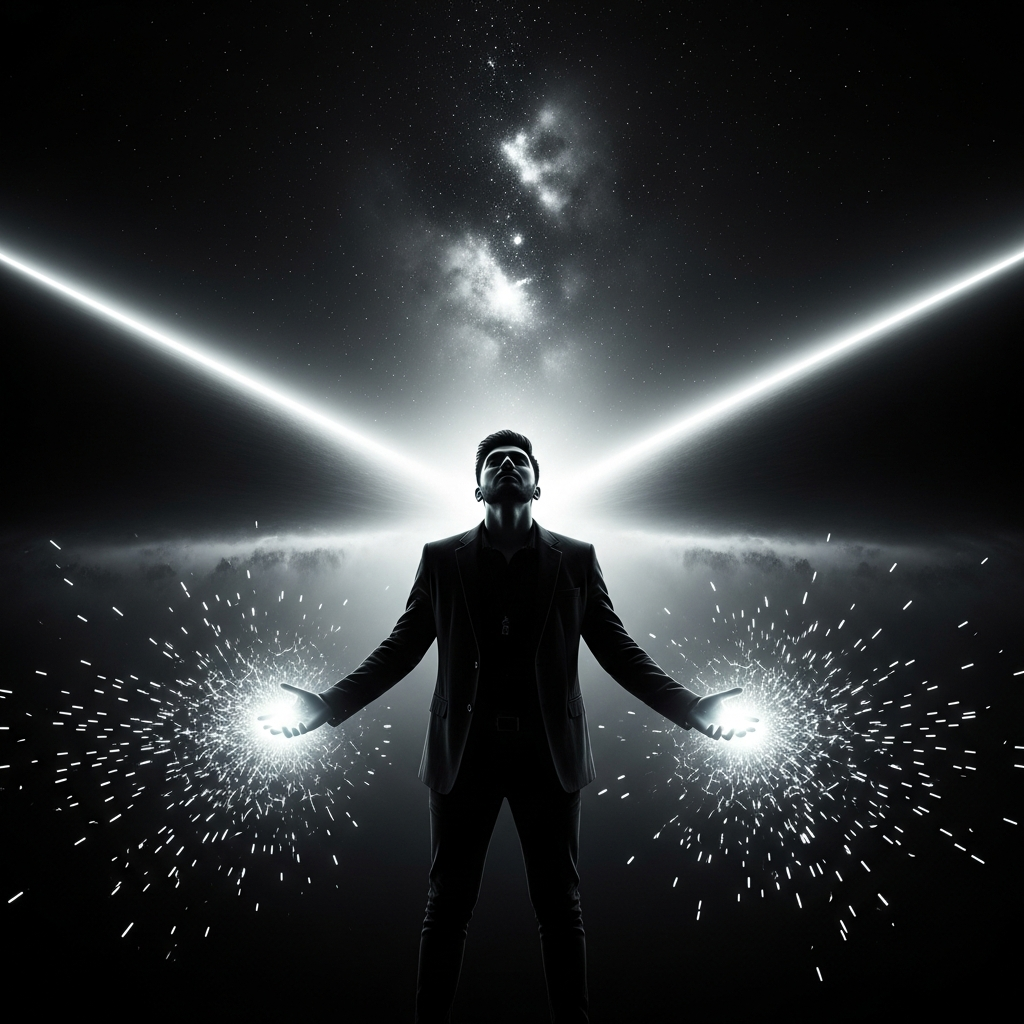
Adesh Ingale stood on the balcony of his eleventh-floor apartment, the morning air biting at his skin with a peculiar, metallic chill. He looked up, expecting the familiar, infinite blue of a clear summer day, but something was profoundly wrong. The sky didn’t look like an atmosphere; it looked like a texture. The clouds were not drifting; they were pulsing, rhythmic and heavy, like the labored breathing of a sleeping giant. Adesh rubbed his eyes, but the sensation of being observed persisted. The blue was too vivid, a saturated, visceral cerulean that felt less like light and more like a vast, stretched membrane. He noticed that the birds had stopped flying, perched in silent rows along the power lines, all their heads tilted upward at exactly the same forty-five-degree angle. Every shadow on the street below seemed to point toward him, not away from the sun, but toward his specific coordinates on the balcony. He felt a prickle at the base of his neck, a phantom gaze that bypassed his skin and settled deep within his marrow. The horizon didn’t curve; it seemed to slightly pucker, as if the world were a bowl being held by something with a very firm grip. Adesh Ingale tried to look away, but his periphery was filled with the unsettling sight of a cloud formation shifting into the unmistakable shape of a gargantuan, lidless tear duct. The silence was absolute—no cars, no wind, just the hum of his own nervous system reacting to the impossible realization that the sky was no longer a place, but a presence that had finally noticed him standing there.
Scene 2
The Pupil of the Moon
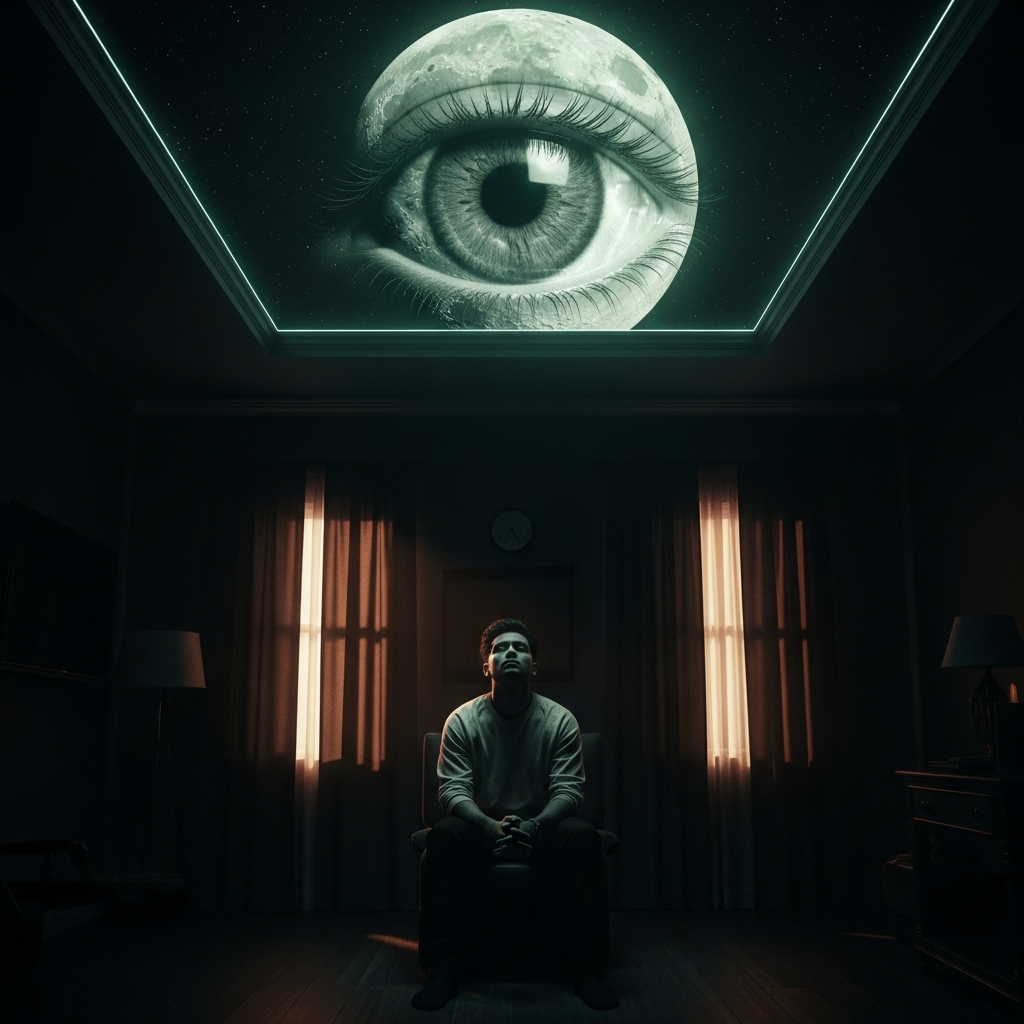
As the sun dipped below the horizon, the darkness Adesh Ingale expected never truly arrived. Instead, the sky transitioned into a bruised, sickly violet, and the moon emerged not as a cratered rock, but as a colossal, luminous pupil. Adesh retreated inside, pulling the heavy velvet curtains shut, but the light bled through the fabric, a rhythmic amber glow that matched the beat of his own panicked heart. He sat in the center of his living room, the floorboards vibrating with a low-frequency hum that sounded like a distant, celestial purr. He looked into his cup of coffee and gasped; the liquid’s surface didn’t reflect his face, but rather a distorted view of the stars, which were now blinking in a coordinated, rapid sequence—a cosmic Morse code intended for an audience of one. Adesh Ingale felt the pressure in his ears mount, the atmospheric weight increasing as if the sky were leaning down to get a better look at him. He realized with a jolt of terror that the walls of his apartment were becoming translucent, the solid brick and mortar turning into a thin, filmy gauze. He was a specimen in a jar, and the entity above was peering through the glass. Every time he blinked, he could feel the sky blinking with him, a synchronized shuttering of reality that left a trail of afterimages burned into his retinas. The air smelled of ozone and ancient dust, and he could hear a faint, wet sound—the sound of a massive eyelid sliding over a moist, planetary surface high above the clouds.
Scene 3
The Veins of the Atmosphere
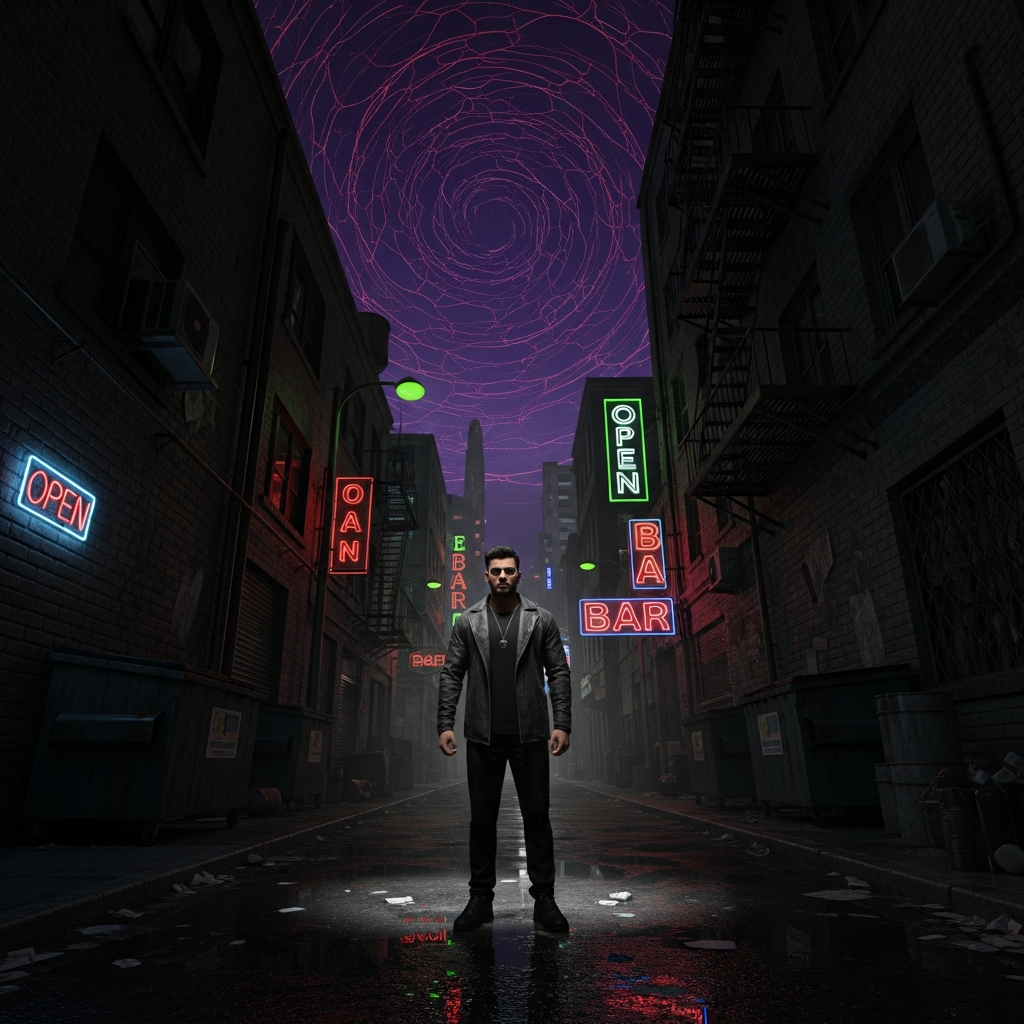
By the third day, Adesh Ingale could no longer deny the biological nature of the firmament. He ventured out into the street, his footsteps echoing in a city that felt abandoned, though the cars remained parked and the shop lights flickered. Looking up, he saw red, bifurcating lines stretching across the zenith—capillaries of light that throbbed with a dull, crimson glow. These weren’t jet trails or weather patterns; they were a circulatory system. Adesh felt a strange, magnetic pull drawing his gaze upward, a command he could barely resist. He saw a skyscraper in the distance being enveloped by a descending fog that looked like a giant, greyish finger, stroking the steel and glass with a tactile curiosity. He realized the sky was reaching down, its invisible fingers probing the world for something specific. Adesh Ingale ducked into an alleyway, but the shadows themselves felt like extensions of that overhead gaze. He looked at his own shadow and saw it stretching toward the sky, thin and elongated, like a thread being pulled toward a needle. The sky began to whisper—not in words, but in a series of clicks and wet pops that resonated inside his skull. It was a language of pure observation, a cataloging of his every fear and memory. He felt his privacy being stripped away, his very soul being mapped by the lidless entity that filled the world from horizon to horizon. He wasn’t just being watched; he was being read like a book held open under a magnifying glass of celestial proportions.
Scene 4
The Descent of the Iris
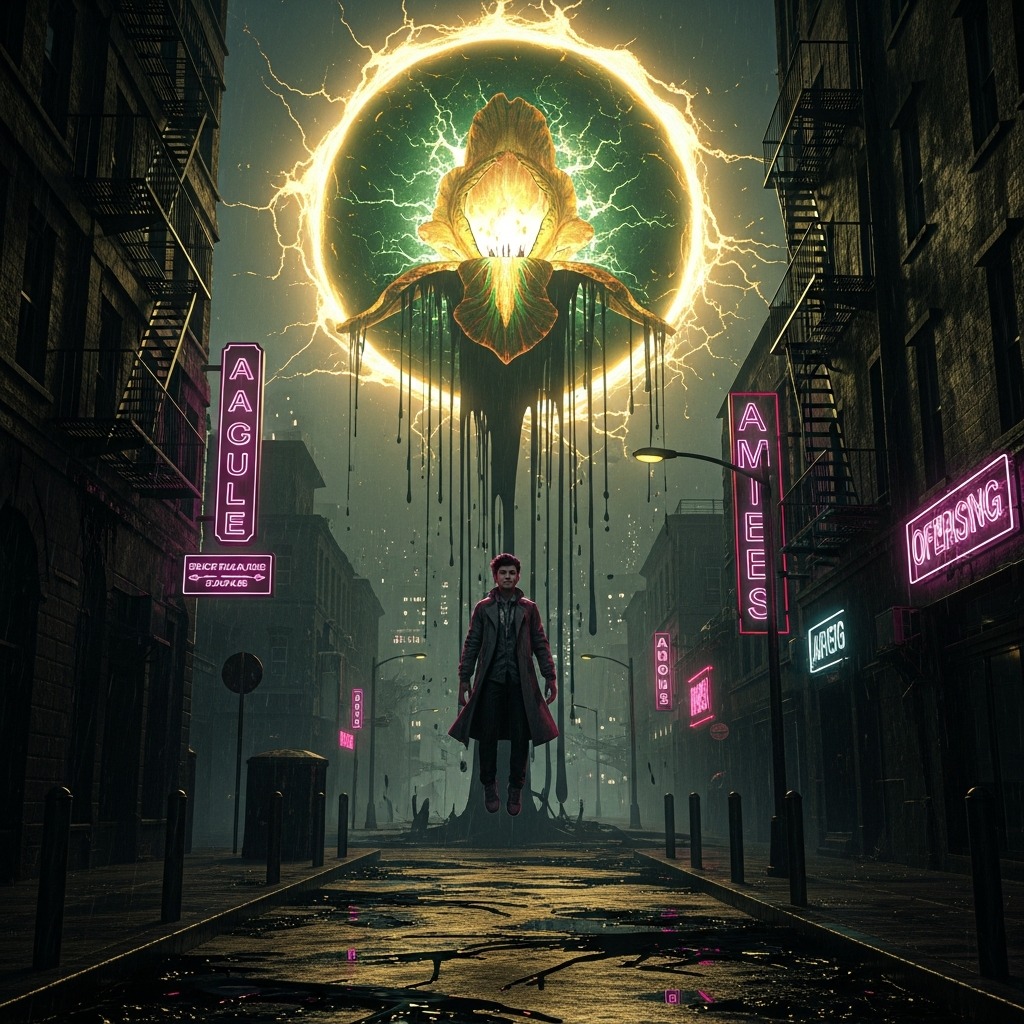
The atmosphere began to thicken, the air turning into a gelatinous substance that made every movement an agonizing struggle for Adesh Ingale. The ‘Iris Event’ began at noon, though the sun had long since been obscured by a massive, circular contraction of the clouds. A ring of gold and green fire formed in the center of the sky, miles wide, spinning with a slow, hypnotic grace. Adesh fell to his knees in the middle of a deserted intersection, the pressure of the gaze now physical, a crushing weight on his shoulders. He looked up and saw the textures of the sky clearly: it was a landscape of wet, shimmering tissue and fibrous muscles. The sky was descending, the ceiling of the world lowering until the tallest buildings began to pierce the ‘skin’ of the clouds, causing a downpour of warm, translucent ichor. Adesh Ingale screamed, but the sound was muffled by the density of the air. He saw the reflections of the city in the massive golden ring above—a mirror image of the world, but distorted, as if the sky were reflecting its own digestive process. He realized then that the watchfulness wasn’t passive; it was predatory. The sky wasn’t just an observer; it was a mouth, and the iris was the gateway to a throat that spanned the stars. He felt a sudden, violent tug on his center of gravity, his feet lifting off the pavement as the sky began to inhale, drawing the very essence of the city upward into its swirling, ocular maw.
Scene 5
The Ladder of Light
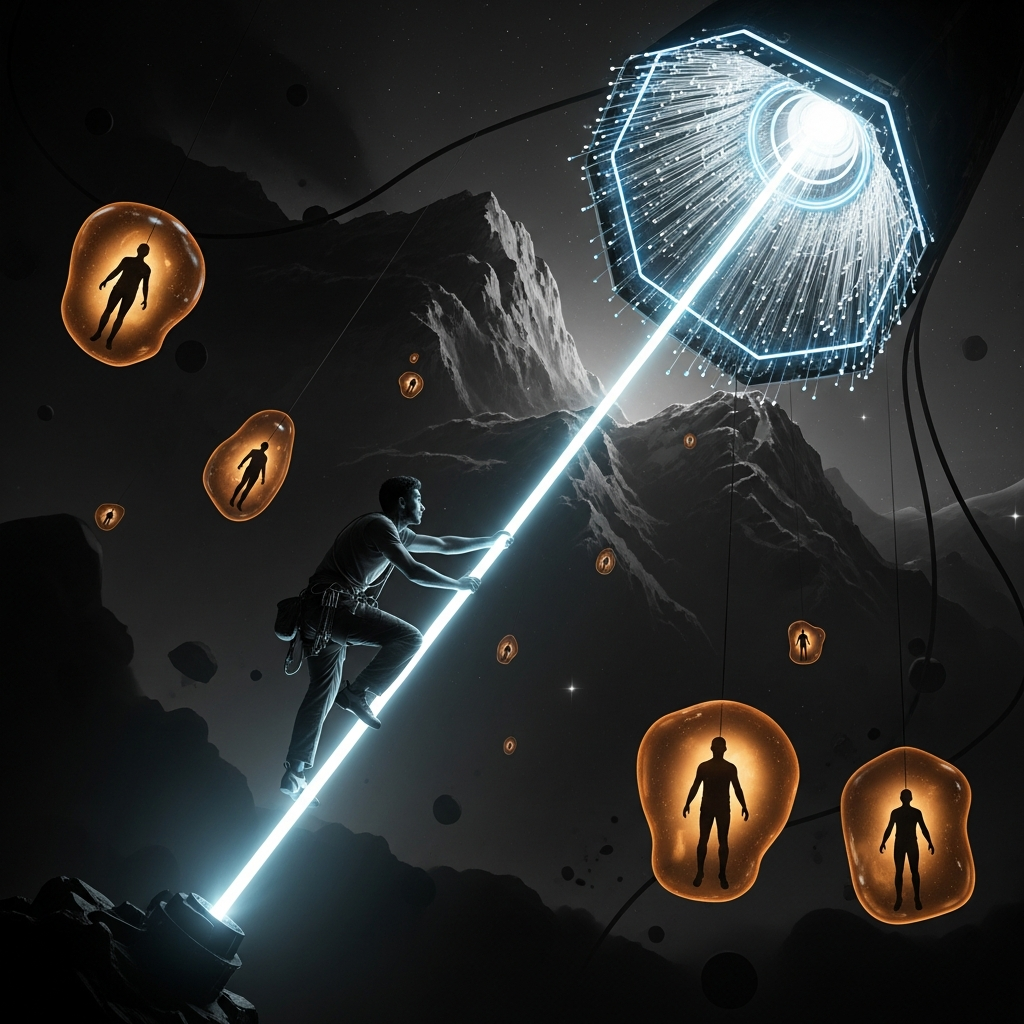
As Adesh Ingale drifted upward, his terror reached a boiling point, then vanished, replaced by a cold, crystalline clarity. He saw beams of solid light descending like the rungs of a ladder, anchored into the asphalt and the earth. He grabbed one, the light feeling like cold, smooth obsidian beneath his palms. He began to climb, driven by a desperate need to face the watcher directly. As he ascended, the city below shrank into a miniature model, then a blur of grey and brown. The air grew thin, but he didn’t need to breathe; the sky was feeding him its own strange oxygen, a mixture of light and thought. Adesh Ingale climbed through the first layer of clouds and found himself standing on a platform of hardened vapor. Above him, the eye was so close he could see the individual fibers of the iris, each one the size of a mountain range. The sheer scale of the entity was incomprehensible, a biological machine that dwarfed the planet. He saw other people, thousands of them, suspended in the amber light, their eyes wide and glowing with the same reflected gold. They were being harvested, their consciousnesses being uploaded into the celestial network. Adesh felt the sky’s curiosity peak; he was different. He hadn’t surrendered to the gaze; he had climbed toward it. The clicking sounds in his head sharpened into a singular, booming vibration that shook his very atoms. ‘Why do you look back?’ the sky seemed to ask, its voice a resonance that felt like thunder in his bones.
Scene 6
The Great Blink
The confrontation reached its climax when Adesh Ingale reached the center of the pupil—a vast, bottomless void that smelled of the beginning of time. He stood on the edge of the abyss, the sky’s consciousness pressing against his mind with the force of a thousand oceans. The ‘Great Blink’ began. The upper and lower horizons started to move toward each other, two massive curtains of darkness that would extinguish the world. Adesh realized that the entity was closing its eye to sleep, and in its slumber, the reality he knew would cease to exist. He wasn’t a specimen anymore; he was an irritant, a speck of dust on the cosmic cornea. With a roar of defiance, Adesh Ingale didn’t turn away. He reached out and touched the void, plunging his hands into the dark matter of the sky’s thoughts. He poured his memories—the smell of rain, the heat of a summer fire, the touch of a hand—into the entity. He used his humanity as a wedge to keep the eyelid from closing. The friction was immense; sparks of blue and white lightning arced from his fingertips, illuminating the internal anatomy of the universe. The sky shuddered, a celestial groan echoing through the dimensions. For a moment, Adesh Ingale was the strongest force in the cosmos, a single human soul resisting the sleep of a god. The blink faltered, the curtains of darkness trembling as they met the barrier of his concentrated will. He felt his physical body dissolving, turning into pure information, a virus of light in the eye of the watcher.
Scene 7
The New Perspective
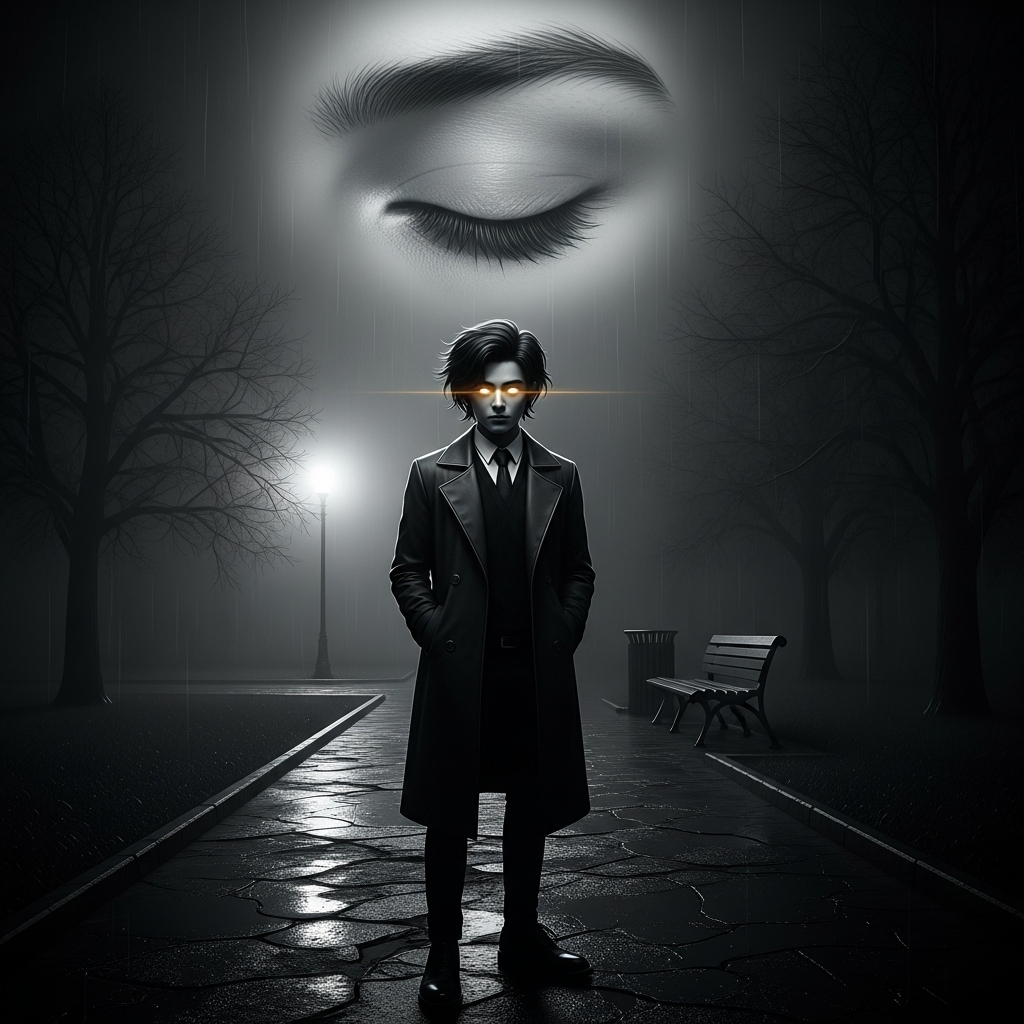
When the light finally settled, Adesh Ingale was no longer on the balcony, nor was he in the void. He opened his eyes and found himself standing in the center of a park, the world around him vibrant and terrifyingly alive. The sky was back to its usual blue, but to Adesh, it was transparent. He could see the intricate layers of the entity behind the veil—the slumbering god, the veins of light, the resting iris. He had survived the blink, but he had been changed. He was no longer the one being watched; he had become a part of the sensory apparatus of the universe. He looked at a passerby, and he could see their thoughts as flickers of color in the air. He looked at a tree, and he could hear the slow, tectonic heartbeat of the earth. Adesh Ingale walked through the city, his presence causing a slight ripple in the atmosphere, a shimmering distortion that followed him like a loyal shadow. He realized that the sky was no longer watching him because he was now the sky’s eye on the ground. The resolution was not a return to normalcy, but an ascension to a higher, more terrifying state of being. He looked up one last time and smiled, and for the first time in his life, the sky smiled back, a subtle shift in the clouds that only he could perceive. The horror was gone, replaced by a cold, eternal companionship. Adesh Ingale was the bridge between the earth and the gaze, the man who looked back until the universe blinked first.