Scene 1
The First Gasp
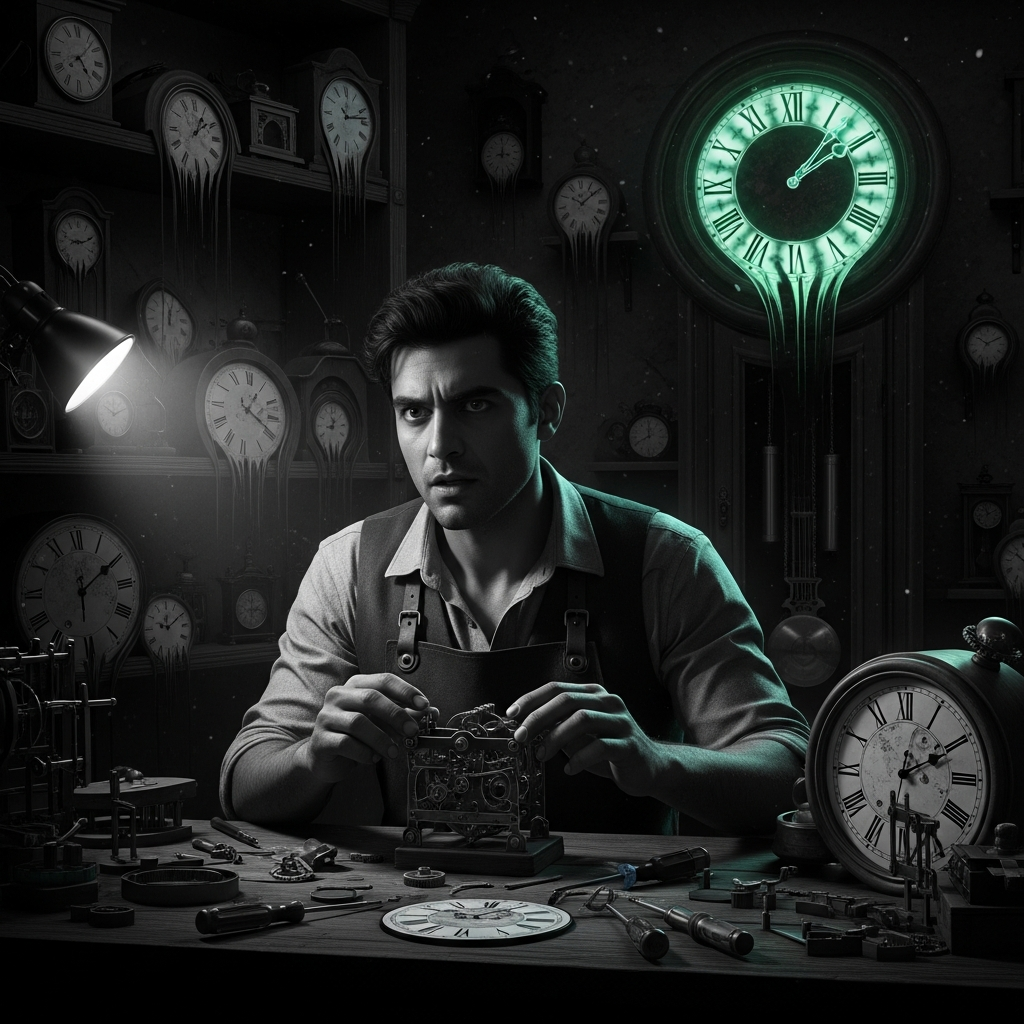
In the dim, oil-scented sanctuary of his workshop, Adesh Ingale hunched over a skeletonized clock movement, his magnifying loupe pressing into his brow. The usual rhythmic ticking of a thousand mechanical hearts suddenly faltered, replaced by a sound that made the marrow in his bones go cold. It was a breath—wet, labored, and impossibly large. It did not come from a person, but from the air itself. Every time the invisible lungs expanded, the shadows in the corners of the room stretched and pulsed like ink in water. Adesh froze, his tweezers trembling as he held a microscopic gear. The sound was a rhythmic heaving, a wheezing inhalation that seemed to draw the very heat from the room. He looked at his workbench and watched in silent horror as a fresh rose in a vase wilted, turned to gray ash, and then bloomed back into a bud within the span of a single ‘exhalation.’ The smell of ozone and rotting lilies filled his nostrils, thick and suffocating. Adesh realized that the silence he had cherished for years was gone, replaced by the respiration of an entity that spanned the beginning and the end of existence. He reached out to touch the air, and his hand passed through a pocket of freezing cold that smelled like old coins and ancient earth. The ticking had stopped entirely now; the clocks were no longer measuring time, they were struggling to survive it. Adesh whispered his own name to ground himself, but his voice sounded like it was coming from the bottom of a deep, rusted well, echoing across centuries before it reached his own ears.
Scene 2
The Erosion of Now
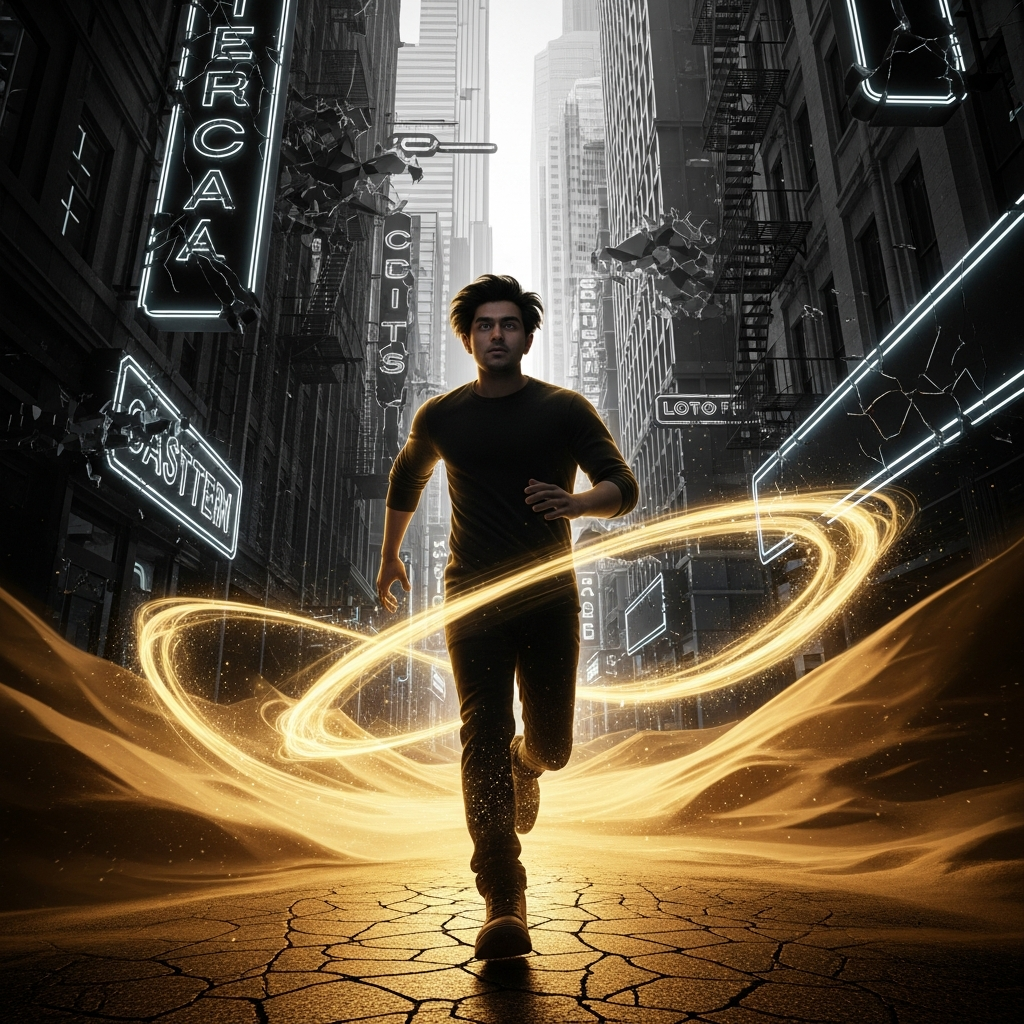
Adesh stepped out of his workshop, but the world he knew had been devoured by the breathing. The street was a flickering strobe light of eras. One moment, the pavement was modern asphalt; the next, it was a muddy track trodden by ghosts of cattle. The sound of the breathing was louder here, a deafening, rhythmic roar that shook the buildings. Adesh watched as a skyscraper to his left rapidly accelerated through its life cycle, the steel rusting into orange dust and the glass shattering as vines grew and died in seconds across its facade. He felt a sharp pain in his chest and looked down to see his own hands. His skin was translucent, showing the rapid pulsing of his veins, which now flowed with gold sand instead of blood. Every breath the universe took was aging him and rejuvenating him in a violent cycle. He saw a child playing with a hoop in the distance, but the child would vanish and be replaced by an old man in a shroud within heartbeats. The sensory overload was agonizing—the taste of iron, the smell of burnt electrical wires, and the constant, wet ‘huff’ of the invisible lungs. Adesh realized he wasn’t just hearing time; he was inside its chest cavity. He had to find the source of the respiration before he was exhaled into non-existence. He began to run, but his footsteps made no sound on the shifting ground, as if the concept of impact had been erased by the overwhelming frequency of the Chronos-breath.
Scene 3
The Clockwork Forest
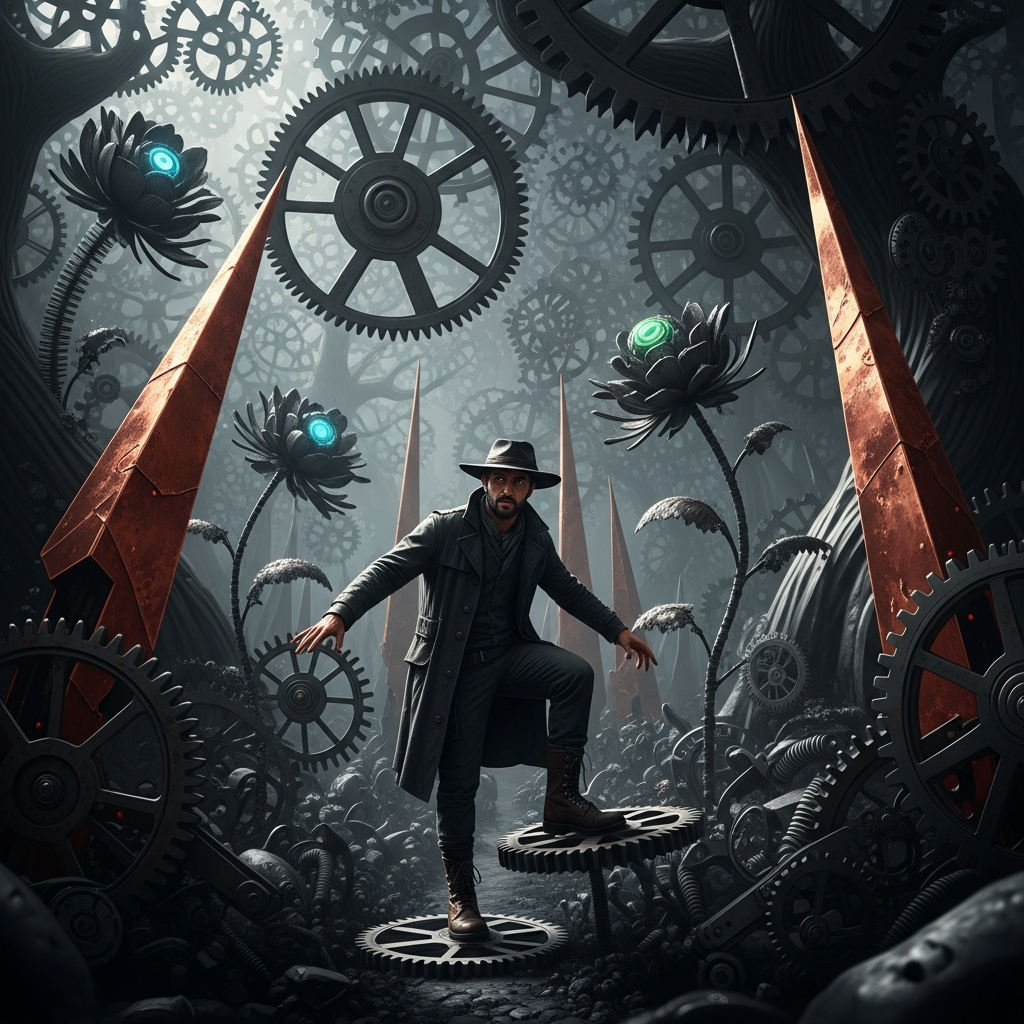
The city dissolved into a landscape that defied every law of geometry. Adesh found himself standing in a forest where the trees were made of rusted iron gears and the leaves were razor-sharp slivers of copper. The breathing was so intense here that it created a wind, a ‘Temporal Gale’ that pushed against him with the weight of centuries. He saw memories of his own life hanging from the metallic branches like ripening fruit—his mother’s face, his first day at the lathe, the smell of rain on a summer afternoon. But these memories were being inhaled by the forest. The gears of the trees groaned as they turned, grinding against each other with a sound like a dying choir. Adesh pushed forward, his leather apron shredded by the copper leaves. He noticed that where his tears hit the ground, small brass flowers instantly sprouted and withered. The sky above was a swirling vortex of clock faces, none of them showing the same hour. He realized the forest was a filter, a biological machine designed to process the ‘waste’ of time. The breathing was the sound of the universe’s metabolism. Adesh’s vision began to fracture, showing him multiple versions of the forest simultaneously. He saw himself as a boy and as a corpse, walking side-by-side. He screamed, but the sound was caught in a gear-toothed branch and crushed into a metallic hum. He was nearing the center, the diaphragm of the world, where the breathing was loudest.
Scene 4
The Altar of the Diaphragm
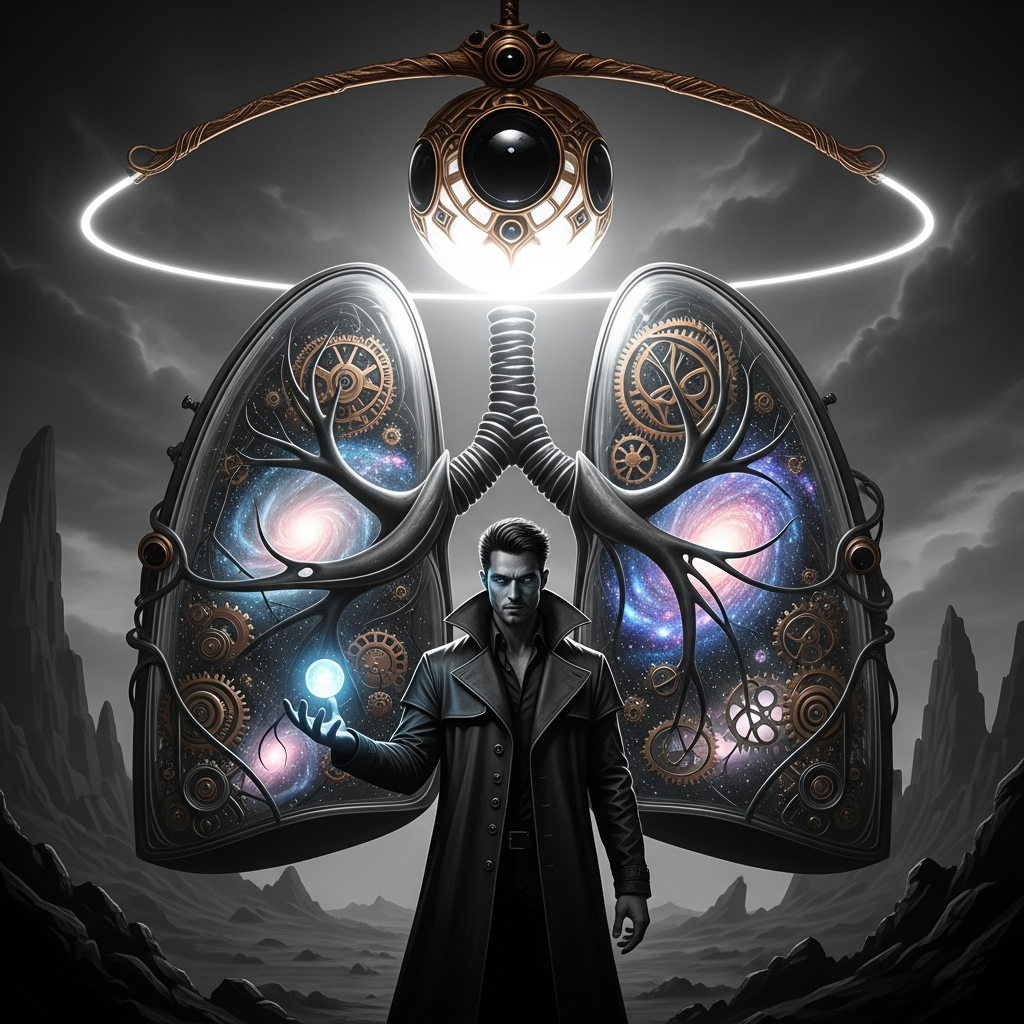
At the heart of the gear-forest lay a vast, pulsating cavern made of calcified bone and brass clockwork. This was the Diaphragm. Here, Adesh Ingale stood before a monumental structure that resembled a pair of translucent, celestial lungs. Inside the lungs, galaxies swirled like trapped smoke, being compressed and expanded with every heave. The sound was no longer just a breath; it was a rhythmic vibration that threatened to liquify Adesh’s organs. He saw the ‘Great Pendulum’ swinging above the lungs, a blade of pure light that sliced through the darkness of the cavern. Each swing dictated the rhythm of the breathing. Adesh realized that the breathing was laboring because it was choked. A mass of ‘Dead Time’—the unlived moments and forgotten histories of humanity—had formed a black, tar-like clod in the center of the mechanism. The universe was suffocating on its own past. Adesh felt a strange kinship with the machine; as a horologist, he had spent his life fixing what was broken. He understood that he hadn’t been called here to witness the end, but to perform a surgery. The air was thick with the scent of ancient dust and the metallic tang of blood. Every time the lungs struggled to expand, the walls of the cavern groaned, and cracks appeared in the fabric of reality, revealing the empty white void outside. Adesh stepped toward the black mass, his hands reaching for the delicate, burning gears that controlled the Great Pendulum.
Scene 5
The Internal Synchronization

As Adesh touched the central mechanism, the breathing stopped. The sudden, absolute silence was more terrifying than the noise. The universe held its breath, and in that stillness, Adesh felt his own heart stop. He was now the only thing moving in a frozen cosmos. To fix the blockage, he had to sync his own pulse with the rhythm of the machine. He reached into the black tar of Dead Time, and his hand was immediately engulfed in a freezing, viscous darkness. He saw flashes of every tragedy, every lost second, and every unsaid word in human history. It was a weight no mortal was meant to carry. His skin began to crack, glowing with the golden light of the ‘Seconds’ he was absorbing. He realized the only way to clear the blockage was to become the conduit. He began to pull the tar out, but it was anchored to the gears of existence. Adesh braced his feet against the bone-floor and pulled with all his might. His muscles tore and reformed; his mind shattered into a million chronologies. He was Adesh the child, Adesh the master, and Adesh the ancient all at once. The Great Pendulum began to vibrate, sensing the shift. The golden sand in his veins began to glow white-hot. He was no longer just a man; he was a living component of the clock. He felt the lungs beneath him quiver, a pre-exhalation tremor that threatened to blow him into the void. He gave one final, primal heave, ripping the mass of Dead Time free and casting it into the path of the light-blade.
Scene 6
The Great Exhalation
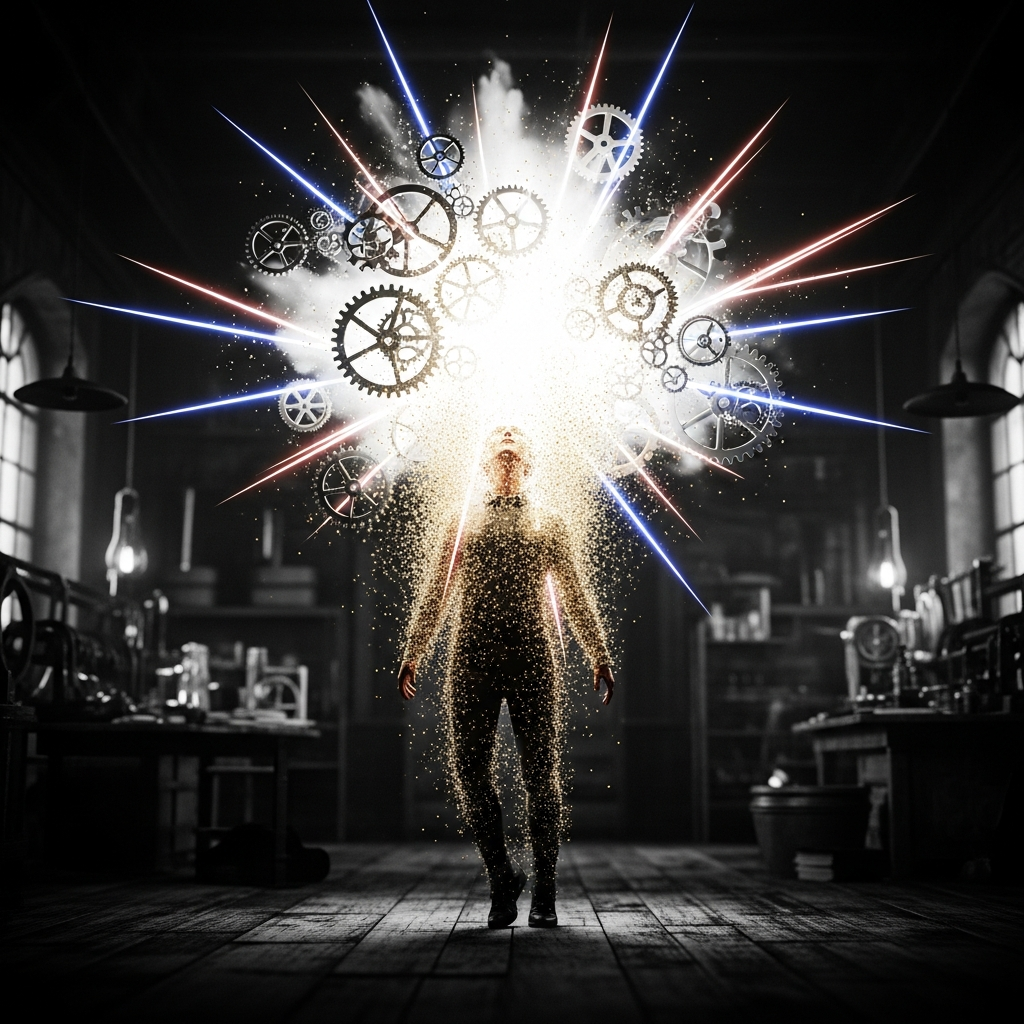
The light-blade of the Pendulum struck the mass of Dead Time, and the resulting explosion was not one of fire, but of pure, unadulterated ‘Now.’ A shockwave of present-tense reality blasted outward, and the lungs finally exhaled. The sound was a majestic, terrifying roar that swept through the cavern, through the gear-forest, and through the city. Adesh was thrown backward by the force of the breath. As the air rushed out of the celestial lungs, it carried the black tar away, dissolving it into harmless stardust. The rhythm returned—deep, steady, and healthy. But the cost was immense. Adesh felt his physical form beginning to dissolve. He was being exhaled along with the waste. He grabbed a spinning gear, his fingers slipping on the smooth brass. The cavern was collapsing, the bone-walls turning back into the shadows of his workshop. He saw the world outside the cavern beginning to stabilize; the skyscraper was whole again, the child was playing with the hoop, and the clocks were ticking in perfect, melodic unison. Adesh realized he had saved Time, but in doing so, he had removed himself from its flow. He was a ‘stray second,’ a moment that had no place left in the sequence. He watched as his workshop materialized around him, but it was silent and empty, a ghost of a place. He reached for his loupe, but his hand passed through it like smoke. The breathing was now a gentle, soothing hum, the sound of a sleeping giant.
Scene 7
The Eternal Guardian of Silence
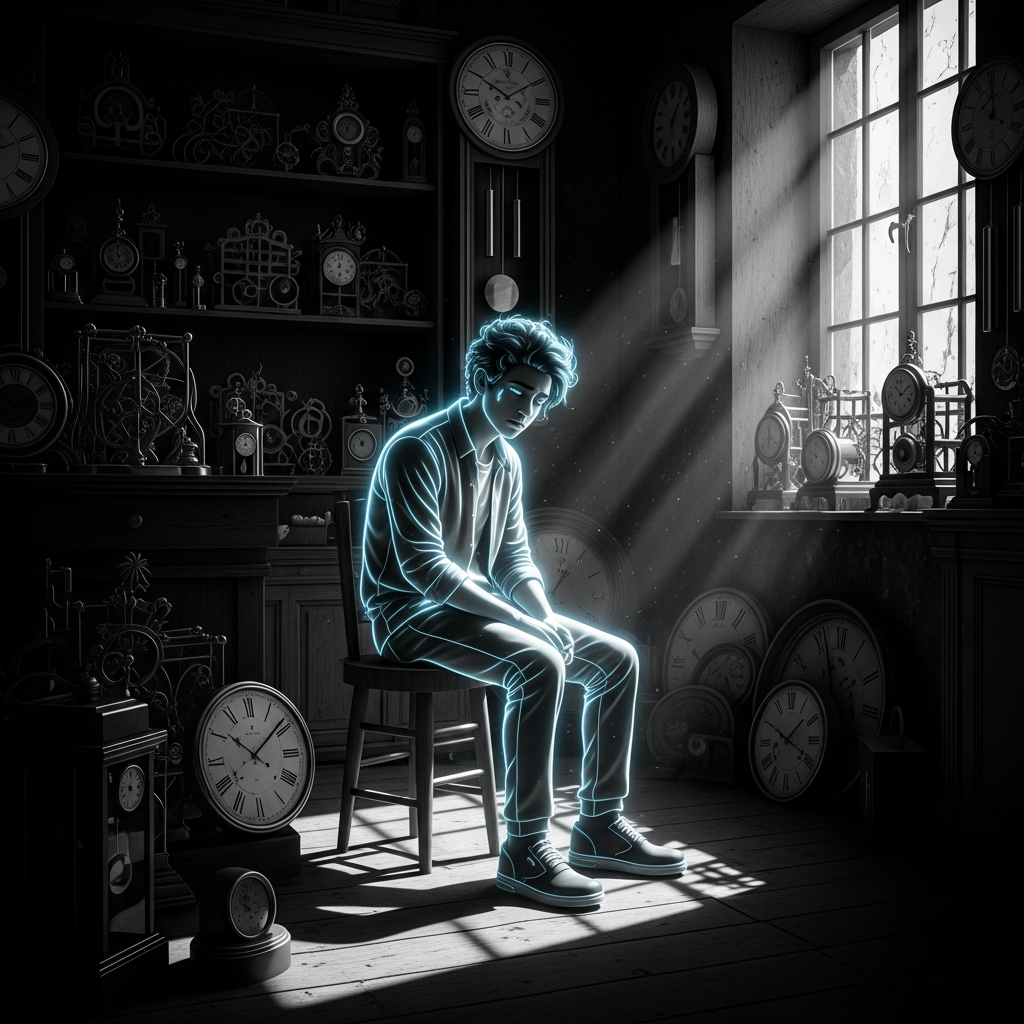
Adesh Ingale sat at his workbench, but he no longer needed the lamp. He was a being of soft, amber light, a permanent fixture in the space between seconds. The workshop was perfectly still, the clocks all showing the exact same, correct time. He could still hear the breathing, but it was no longer a horror; it was a companion. He realized that someone had to stay behind to ensure the blockage never returned. He was the new Horologist of the Void. He picked up a ghost-tool and began to work on a watch that didn’t exist in the physical world. Outside, the world moved on, unaware of the man who had saved their ‘tomorrow’ by sacrificing his own. Occasionally, a customer would enter the shop, find it empty and dusty, and leave with a shiver, sensing a presence they couldn’t name. Adesh would watch them, his eyes filled with a peace that surpassed understanding. He saw the beauty in every ticking second, every breath taken by the living. He was the silence that allowed the music of time to be heard. He closed his eyes and listened to the pulse of the universe—the steady, rhythmic breathing of existence. It was the most beautiful sound he had ever heard. He was Adesh Ingale, the man who heard time breathing, and now, he was the one who made sure it never had to stop. The story of his life was over, but his existence had become the very rhythm of the world.