Scene 1
The Stutter in the Silver
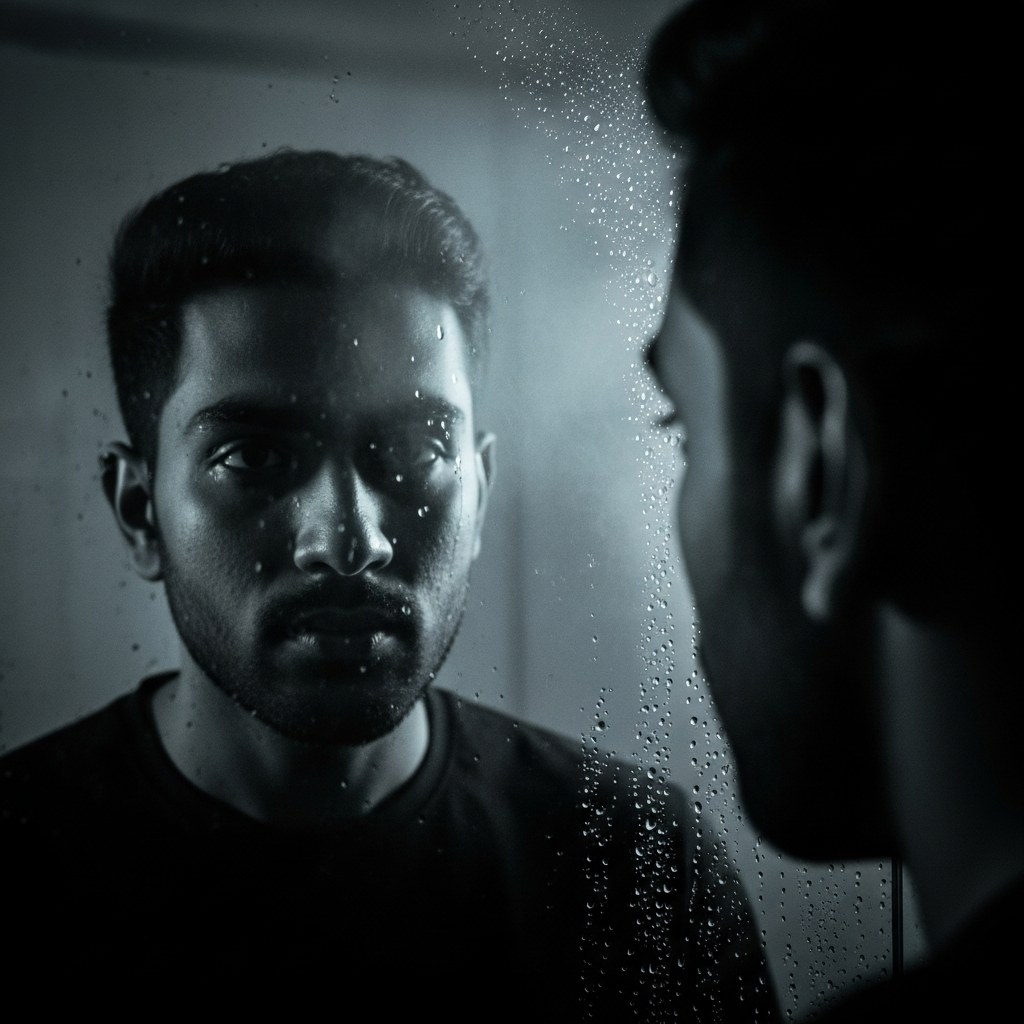
The morning routine was a ritual of clockwork precision for Adesh Ingale. The bathroom was thick with the scent of sandalwood shaving cream and the heavy, humid veil of steam from the shower. As Adesh raised his vintage safety razor to his jaw, he paused. The man in the mirror—his twin in every detail—was a fraction of a second behind. It was a microscopic lag, a stutter in reality that shouldn’t exist. Adesh froze, his heart hammering against his ribs like a trapped bird. He blinked, and for a heartbeat, his reflection remained wide-eyed while Adesh’s own lids were closed. When he opened them, the image had caught up, but the air in the room had turned glacially cold. Adesh touched the glass; it didn’t feel like cold silica, but like the surface of a deep, still pond. He watched his reflection’s hand mimic his own, but there was a predatory hunger in the double’s eyes that hadn’t been there before. The steam began to swirl abnormally, forming shapes that defied the natural drafts of the room. Adesh tried to laugh it off as sleep deprivation, but the silence that followed was too heavy, too absolute. He turned to leave, but the reflection didn’t turn with him. Out of the corner of his eye, he saw the mirror-Adesh stay perfectly still, the razor still pressed against a throat that wasn’t there. It was the first breach in the contract of existence, and Adesh felt the first drop of icy dread slide down his spine, marking the beginning of the end.
Scene 2
The Abandoned Image
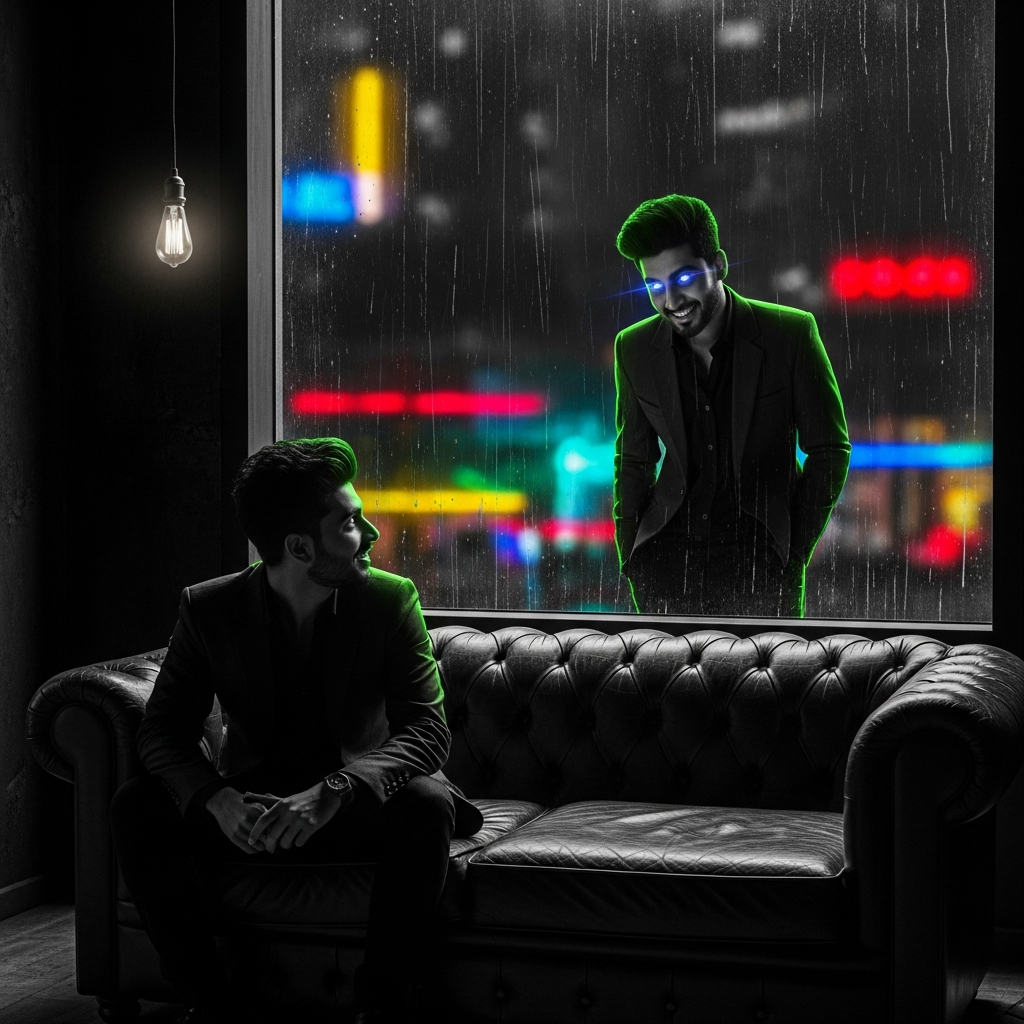
Adesh walked into his living room, his skin crawling with the sensation of being watched. He deliberately avoided the hallway mirror, but the polished surface of the television and the glass-fronted cabinets offered no sanctuary. In every reflective surface he passed, he caught glimpses of a figure that was no longer his slave. When he sat on his leather sofa, the reflection in the darkened window across the room didn’t sit. It stood, tall and imposing, silhouetted against the streetlights outside. Adesh Ingale was a man of logic, but logic was failing him. He watched in paralyzed fascination as the reflection walked toward the edge of the glass frame, its movements fluid and arrogant. It was as if the glass were a window into a parallel apartment where a darker version of himself lived a different life. The reflection reached out, its fingers pressing against the inside of the windowpane. Adesh heard a faint, high-pitched ringing, the sound of silver vibrating at an impossible frequency. The reflection’s face was inches from the glass, its features twisted into a mocking sneer. Adesh realized with a jolt of terror that the reflection wasn’t just staying behind; it was waiting for an opening. Every time he turned his head, the entity in the glass moved closer to the boundary. The boundary was thinning, the silver nitrate of the mirrors dissolving into a gateway. He was no longer the master of his own image; he was an observer to a slow-motion invasion of his own identity.
Scene 3
Urban Specter

The city of Mumbai offered no escape for Adesh. He fled his apartment, thinking the chaos of the streets would dilute the horror, but the glass-clad skyscrapers became a thousand-eyed monster. As he walked past the storefronts of Bandra, his reflection leaped from one window to the next, keeping pace with him but refusing to match his gait. People bumped into Adesh, annoyed by his erratic movements, but none of them noticed the anomaly in the glass. To the world, the reflection was normal; only Adesh could see the truth. His mirror self was now actively mocking him, miming a throat-slitting gesture as it passed a jewelry store. Adesh’s breathing became shallow, a frantic rasping in the humid air. He saw his reflection walk through a puddle on the pavement, but the splash didn’t match his footsteps. The reflection was growing more solid, more vibrant, while Adesh felt his own color fading, his presence in the physical world becoming strangely translucent. He ducked into a dark alleyway, away from the windows, only to find a discarded, broken mirror lying in the trash. Even in the shards, dozens of mini-Adeshs stared up at him, their faces fragmented and horrific, all whispering in a voice that sounded like grinding glass. ‘You are the shadow now,’ the fragments hissed in unison. Adesh screamed, kicking the shards away, but the sound was muffled, as if the air itself was becoming a liquid barrier. He was losing his grip on the tangible world, the silver threads of the mirror realm pulling at his soul.
Scene 4
The Liquid Membrane
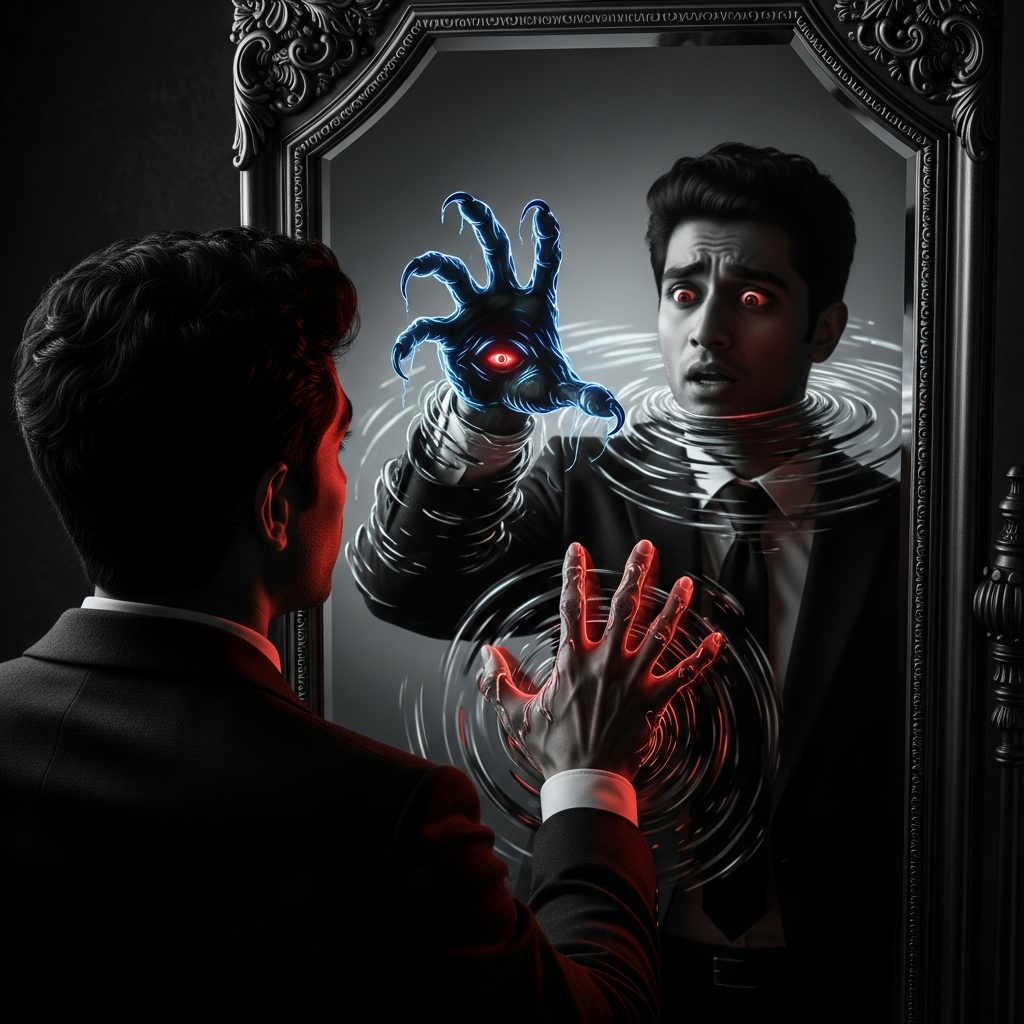
Adesh returned home, driven by a desperate need to confront the source. He stood before the great antique floor-length mirror in his bedroom, a family heirloom that now felt like a tombstone. The reflection was there, waiting. It wasn’t just a visual copy anymore; it had depth, a three-dimensional weight that seemed to displace the very air behind the glass. Adesh reached out, his hand trembling. As his fingers touched the surface, the glass didn’t resist. It rippled like the surface of a dark lake. A coldness, deeper than any winter, surged up his arm, numbing his nerves and turning his blood to slush. The reflection reached out too, its hand emerging from the glass, solid and warm—more real than Adesh’s own flesh. The two hands met in the middle, fingers interlacing. Adesh tried to pull away, but the grip was like iron. The reflection’s skin was tan and healthy, while Adesh looked down to see his own skin turning a dull, metallic gray. The silver was spreading, a slow-moving petrification that started at his fingertips. The room around him began to lose its vibrancy, the colors bleeding out into the mirror, sucked into the voracious void of the silvered world. He could smell the ozone of the reflection’s world—a scent of ancient dust and stagnant water. He realized then that this wasn’t a haunting; it was a harvest. The reflection was the hunter, and Adesh was the prey whose very essence was being siphoned through the silver membrane.
Scene 5
The Great Inversion
Visual Synchronization Offline
The struggle was silent and agonizing. Adesh Ingale fought with every ounce of his will, but the physics of the mirror world were absolute. He was being pulled into the frame, his shoulders disappearing into the cold, shimmering surface. The sensation was like being flayed and frozen simultaneously. Inside the mirror, the world was a perfect, inverted replica of his bedroom, but everything was cast in a haunting, monochromatic blue. He saw his reflection—the ‘Other’—stepping out into the ‘real’ room. The Other inhaled deeply, savoring the smell of the sandalwood and the warmth of the humid air. It stretched Adesh’s muscles with a sickening crack of satisfaction. Adesh, now half-submerged in the glass, tried to scream, but the only sound that emerged was a faint clinking of crystal. He saw his life from the perspective of the glass, a flat, two-dimensional view of a world he no longer belonged to. The Other turned back to the mirror, adjusting its tie with a sinister perfection. It leaned in close, its breath fogging the surface on the outside, creating a cloud that obscured Adesh’s fading vision. ‘Thank you for the life, Adesh,’ the Other whispered, the voice vibrating through the glass like a funeral bell. ‘It’s much warmer out here.’ With a final, violent lurch, the world flipped. The floor beneath Adesh vanished, replaced by the ceiling of the mirror world. He fell onto the cold, hard surface of the silver floor, looking up at the back of a man who was wearing his face, his clothes, and his life.
Scene 6
Behind the Silver Veil

Adesh stood up in the silent world. Everything was backward. The clock on the wall moved counter-clockwise, and the text on his book covers was a jumble of unreadable runes. He rushed to the glass, pounding on it with fists that felt like heavy stones. The surface was hard as diamond now, unyielding and cold. On the other side, the impostor was living. Adesh watched through the silver veil as the Other picked up his phone and answered a call from his mother. The impostor’s voice was perfect—the same cadence, the same warmth, the same lies. Adesh watched in horror as the Other laughed, a sound he couldn’t hear but could see in the rhythmic movement of the chest. The ‘real’ world outside looked like a vibrant, unreachable dream. He saw his wife enter the room, and the impostor kissed her forehead with a tenderness that made Adesh’s soul scream in agony. He was a ghost in the silver, a captive witness to his own replacement. He roamed the mirror-house, finding that it ended at the edges of the reflective surfaces. Beyond the windows of the mirror-house was nothing but an infinite, swirling gray void—the ‘nothingness’ that exists behind the silvering of a mirror. He was trapped in a prison of his own identity, a limited loop of space where every object was a cold, hollow imitation of the real thing. He realized he wasn’t just in a mirror; he was the new reflection, bound by the law to mimic the movements of the man outside, whether he wanted to or not.
Scene 7
The Eternal Mimic

Years seemed to pass in the silent, silvered dark, though time had no meaning in the reflection. Adesh Ingale had become a master of his own misery. He was forced to move when the Other moved, to smile when the Other smiled, to grow old as the Other grew old. His original self—the man in the real world—lived a life of success and joy, fueled by the stolen vitality of the original Adesh. But there was a flicker of hope in the darkness. Adesh noticed that when the Other was near small, cracked mirrors, the bond weakened. One evening, the impostor, now older and arrogant, stood before the same antique mirror with a glass of wine. He was celebrating a promotion, his face flushed with stolen life. Adesh didn’t mimic the smile this time. He concentrated every ounce of his bitterness, every spark of his frozen soul, into a single point of resistance. The impostor froze, his arm mid-raise. For the first time in decades, the reflection stayed behind. The Other’s eyes widened in realization, the wine glass slipping from his hand. As it shattered on the floor, the cracks in the real world mirrored the cracks in the silver prison. Adesh felt the membrane shatter. He didn’t escape, but he pulled the impostor down with him. As the glass shards flew, the two versions of Adesh Ingale were locked in an eternal, fragmented struggle, neither fully real, both trapped in the broken pieces of a life that had been severed by a single morning’s delay. The story of Adesh ended not with a resolution, but with a thousand different faces staring out from a thousand different shards, none of them knowing which one was the original.