Scene 1
The Smudge of Identity
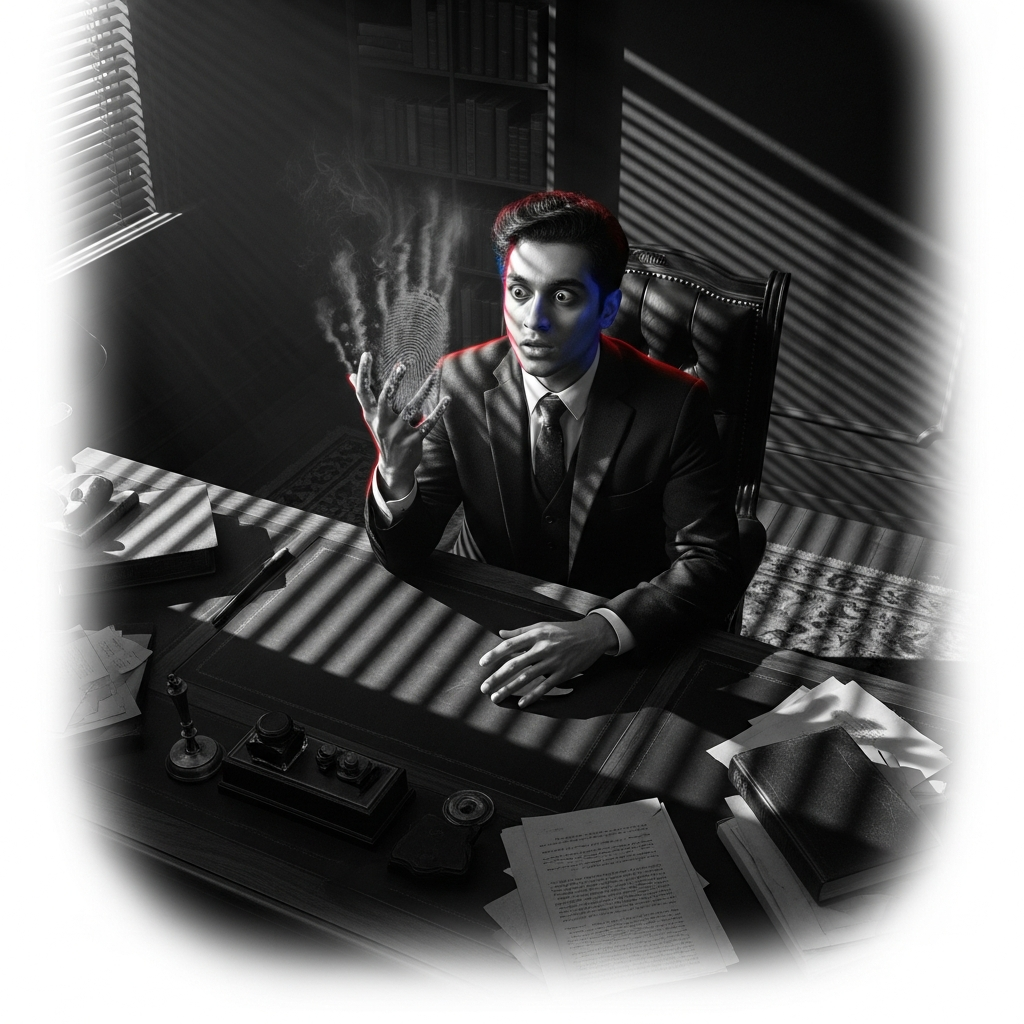
Adesh Ingale sat at his mahogany desk, the familiar weight of his fountain pen grounding him against the creeping chill of the evening. As he signed his name onto the morning’s correspondence, he watched with mounting horror as the ink didn’t just dry—it recoiled. The loops of the ‘A’ and the sharp descent of the ‘I’ began to soften, the pigment turning into a fine, grey mist that drifted off the paper like steam. Adesh rubbed his eyes, but the sensation of his own eyelids felt wrong, like velvet rubbing against wet silk. He looked down at his hand; the fingerprints were smoothing out, the intricate ridges of his identity being buffed away by an invisible sandpaper. The room began to lose its sharp edges. The corner of the desk seemed to melt into the shadows, not into darkness, but into a pale, featureless void. There was no pain, only a sickening sense of subtraction. He tried to scream, but the sound was muffled, as if he were shouting through a mile of cotton wool. The smell of old books and coffee was replaced by a sterile, ozone-heavy neutrality. Adesh grabbed his phone to call for help, but the screen was a blank slate of white light, devoid of icons or life. He was still there, but the world was beginning to forget how to render him. The floor beneath his feet felt less like wood and more like a memory of wood, yielding and soft, threatening to swallow his very footsteps as the first stage of the erasure took hold of his physical reality.
Scene 2
The Muted Thoroughfare

Desperate for the confirmation of others, Adesh Ingale stumbled out into the bustling city street, but the chaos of the metropolis had become a ghostly pantomime. The roar of engines and the chatter of pedestrians were dampened to a low, rhythmic thrumming, like a heartbeat heard from inside the womb. People brushed past him, their shoulders passing through his as if he were made of smoke. Adesh reached out to grab a passerby’s arm, but his fingers slipped through the wool of the man’s coat without any resistance, leaving behind a faint trail of white vapor. The sky above was no longer blue or grey; it was a flat, untextured canvas of pale pearl. Storefronts lacked names, and the faces of the crowd were becoming smooth, their features bleeding into one another like unfinished clay sculptures. Adesh screamed his name—’Adesh Ingale!’—into the void, but the words felt heavy in his mouth, turning into physical ash that fell from his lips before they could reach anyone’s ears. He saw his reflection in a shop window and recoiled; he was a charcoal sketch caught in a rainstorm, his outlines blurring and his colors leaching into the pavement. The world was not dying; it was simply retracting its invitation for him to exist. Every step he took felt like he was treading on a cloud of forgetting, the concrete beneath him softening into a sponge-like substance that left no trace of his passing. He was becoming a ghost while still tethered to a heartbeat that grew quieter with every passing second.
Scene 3
The Archive of Ash
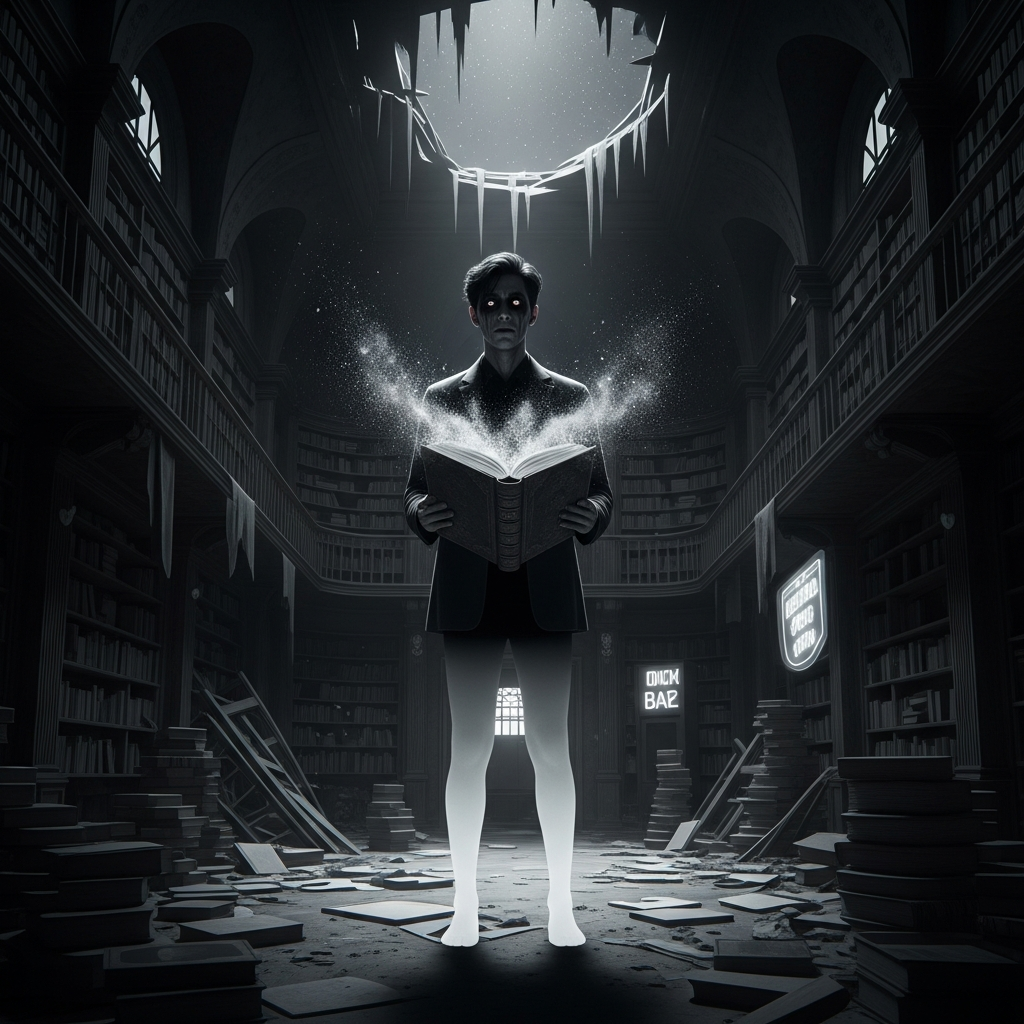
Drawn by a primal instinct to find his record, Adesh Ingale found himself at the Hall of Records, a monolithic building that now looked like it was made of salt. Inside, the tall shelves groaned under the weight of crumbling ledgers. He sprinted to the section containing his birth records, his breath coming in shallow, silent gasps. When he pulled the heavy tome from the shelf, it disintegrated in his hands, the paper turning into a fine white powder that coated his translucent skin. Every document he touched met the same fate. He watched in frantic despair as photographs of his childhood flickered and vanished, the images of his parents turning their backs to the camera before being replaced by a stark, blinding whiteness. Adesh felt a chunk of his memory slip away—the name of his first school, the taste of his favorite meal, the color of his mother’s eyes. They weren’t just forgotten; they were being deleted from the fabric of time itself. The air in the archive was cold and smelled of nothingness. As he looked down, his legs were now semi-transparent, the patterns of the marble floor visible through his shins. He was a glitch in the universe’s ledger, a line of code being overwritten by a silent, cosmic eraser. The silence in the room was absolute, a heavy pressure that pressed against his eardrums, demanding that he surrender to the softening. He realized then that the erasure wasn’t an attack from the outside; it was a systemic failure of his own presence in the world’s grand narrative, a quiet exit he never consented to take.
Scene 4
The Tactile Dissolve

Retreating to his apartment, Adesh Ingale hoped the familiarity of home would anchor him, but the sanctuary had turned into a trap of dissolution. He tried to sit on his sofa, but he sank through the cushions, his body merging with the fabric in a way that felt like a slow-motion drowning. The objects he once cherished—a brass clock, a framed degree, a vintage camera—were losing their weight. When he picked up the camera, it felt like holding a shadow; he could see his palm through the metal casing. The ticking of the clock slowed down, each beat sounding like a heavy drop of water falling into a deep, dark well. Adesh looked at his reflection in the hallway mirror and saw only a smudge of grey where his face should be. The horror was not in the pain, for there was none, but in the absolute lack of impact he had on his environment. He knocked a glass over, but it didn’t shatter; it simply folded into the floor like paper, disappearing into the white abyss that was now consuming the corners of the room. His very thoughts were becoming difficult to grasp, slipping away like eels in dark water. He struggled to remember why he was afraid, the concept of ‘fear’ itself becoming a blurred word in a language he was rapidly forgetting. He was a sculpture being returned to the quarry, a melody being played backward into silence. The tactile world was rejecting him, pushing him out into the margins where only the unmade things reside.
Scene 5
The Great Eraser
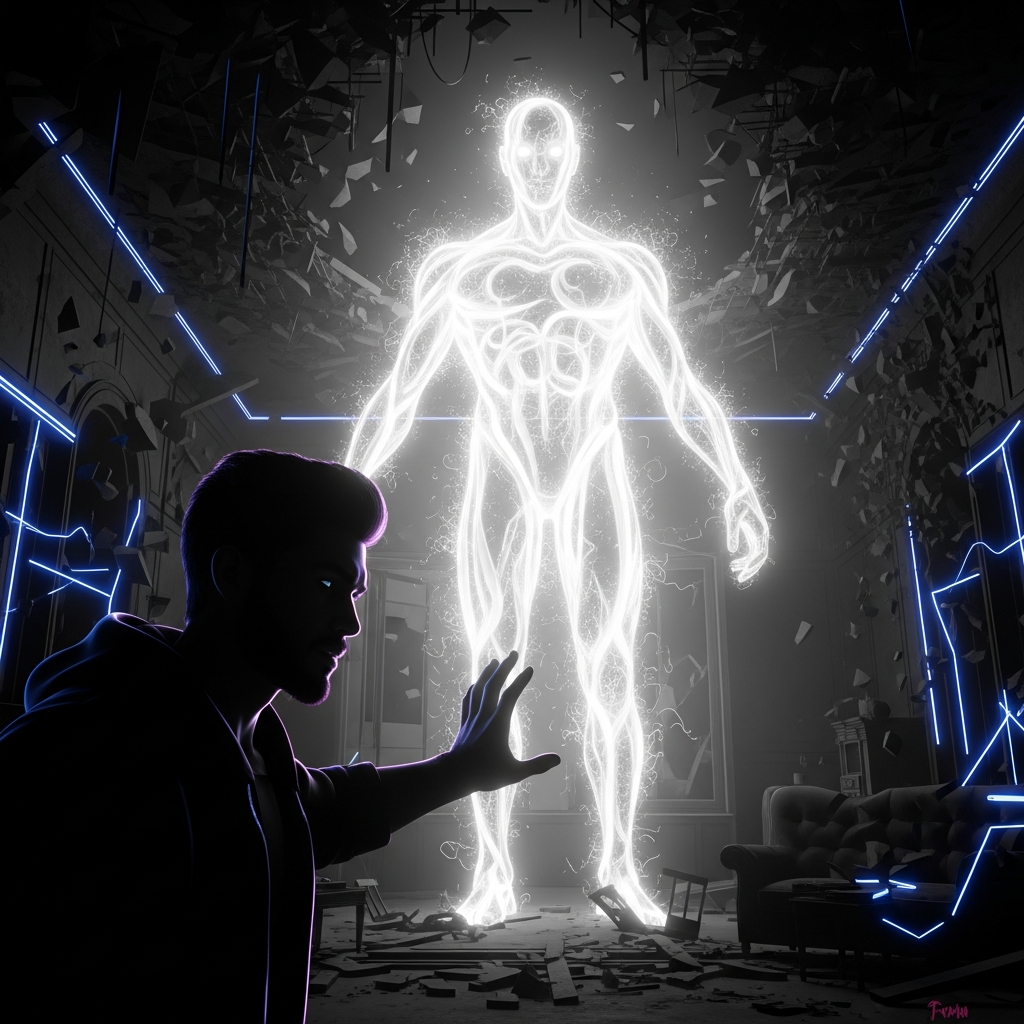
At the center of his living room, a rift opened—not a hole of darkness, but a tear of pure, agonizing light. From the rift emerged a figure that Adesh Ingale could only describe as ‘The Absence.’ It was a towering entity of shifting gradients, a silhouette of negative space that absorbed the very concept of form. It didn’t speak with a voice; it resonated with the sound of a thousand erasers hitting paper. Adesh felt himself drawn toward the entity, his remaining physical substance vibrating in sympathy with the void. The Absence was the personification of the ‘Soft Erasure,’ the cosmic janitor tasked with removing those who had strayed too far from their destined paths. Adesh tried to plead, to offer a reason for his continued existence, but his throat was now a hollow tube of mist. The entity reached out a hand that was less a hand and more a suggestion of one, and where it touched the air, reality simply ceased to be. Adesh realized that he wasn’t being punished; he was being corrected. The universe had found a typo in its grand design, and he was the word that needed to be removed. The pressure of the entity’s presence was like a soft pillow being pressed over his entire existence. He felt his heart—the last solid thing in his chest—start to lose its rhythm, the beats becoming soft thuds that echoed the entity’s pulsing white light. This was the climax of his unmaking, the final confrontation between a man who wanted to be and a force that required him not to be.
Scene 6
The Crimson Script

In a final, desperate act of defiance, Adesh Ingale realized that to be remembered by the world, he had to leave a mark that couldn’t be softened. He bit down on his lip, and for a moment, the sharp sting of pain brought a flash of vivid red back into his grey world. His blood was the only thing that still held the weight of reality. Using his fading fingers, he dipped them into the crimson liquid and began to carve his name into the white, featureless floor. He didn’t just write; he gouged. ‘ADESH INGALE,’ he wrote, the letters jagged and raw. As he wrote, the entity recoiled, the pure red of his life force acting like a toxin to the sterile whiteness of the erasure. He poured every memory he had left—the smell of rain, the warmth of a first kiss, the sting of failure—into the strokes of his name. The floor groaned, the white void cracking under the weight of his blood. He was anchoring himself to the world through the sheer will of his suffering. The more he wrote, the more solid he became. His fingerprints returned, stained with red; his heartbeat roared back to life, a thunderous drum in the silence. He was reclaiming his space, one bloody letter at a time. The entity shrieked, a sound like tearing silk, as the reality of Adesh’s pain proved too sharp for its soft world to contain. He was no longer a typo; he was a scar on the universe, and a scar cannot be erased as easily as a pencil mark. He fought with the fury of a man who refused to be a footnote.
Scene 7
The Permanent Scar
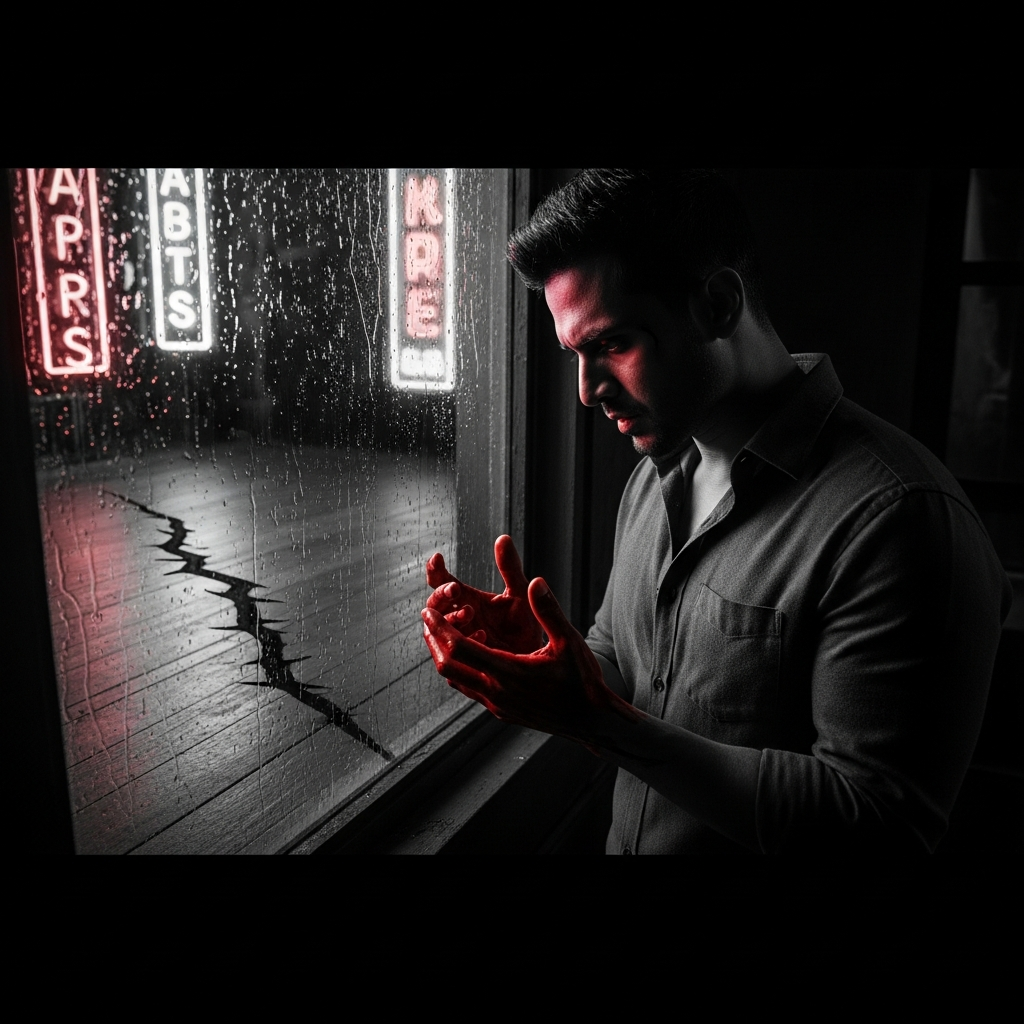
The sun rose over a world that was sharp once again. Adesh Ingale woke up on the floor of his study, the mahogany desk solid beneath his touch. He was no longer fading, but he was changed. He looked at his hands; they were whole, but his palms bore the faint, permanent stains of the blood he had used to write himself back into existence. His name, carved into the floor, remained—a deep, dark trench in the wood that no amount of sanding could ever remove. He walked to the window and looked out at the city. The people had faces again, the sounds were loud and chaotic, but there was a subtle shift in the air. When people looked at him now, they didn’t just see him; they couldn’t look away. He was a fixed point in their vision, a heavy presence that demanded acknowledgment. He had survived the soft erasure, but he had lost the ability to be forgotten. Every step he took left a distinct, echoing thud. He was the only person in the world who was truly, undeniably real. He picked up his fountain pen, and this time, the ink stayed. It didn’t just stay; it bled into the paper with an intensity that seemed to vibrate. Adesh Ingale smiled, a sharp, jagged expression. He had been erased softly, but he had returned hard. He was a permanent resident of reality now, a man whose existence was bought with the price of his own blood, forever etched into the ledger of the living, a ghost that refused to leave the machine.