Scene 1
The Bleaching of the Self
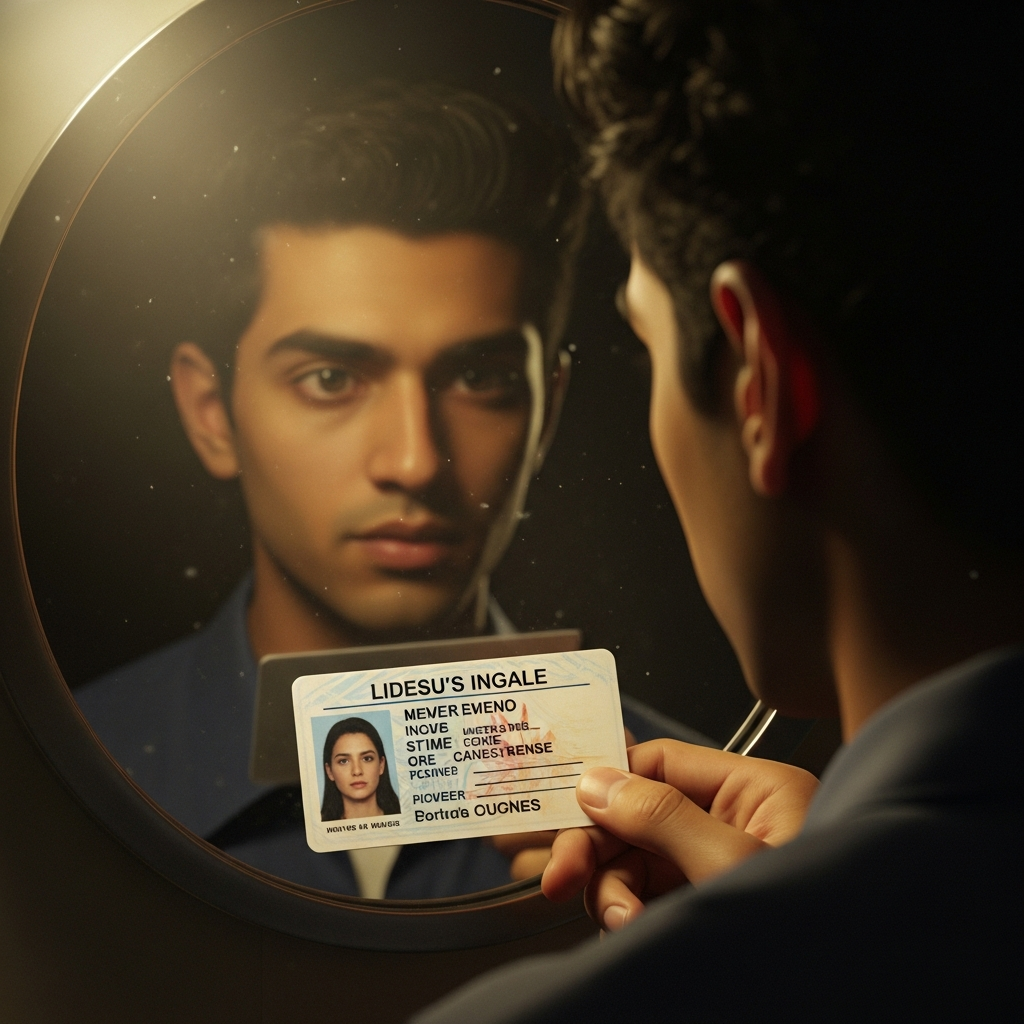
Adesh Ingale woke to the sound of silence, a heavy, velvet-like quiet that seemed to coat the walls of his apartment like a physical residue. The morning light was a sickly, pale yellow, filtering through the blinds like watered-down bile. He reached for his phone on the nightstand, but the screen flickered with a static he had never seen before—a frantic, rhythmic dance of gray and white pixels. His thumb traced the familiar path to unlock it, but when the lock screen appeared, the space where his name usually sat above the time was a jagged, empty hole in the digital interface. Panicked, he stumbled to his mahogany desk and grabbed his wallet with trembling hands. He pulled out his driver’s license, his heart hammering against his ribs like a trapped, frantic bird. The plastic was cool and slick, but the name field was a smooth, unblemished white. It wasn’t merely erased; it was as if the ink had never touched the surface. He checked his passport, his credit cards, even the old library card he’d kept since high school. Every single one was a blank slate, a vacuum where his identity used to reside. The air in the room suddenly felt thin, lacking the vital oxygen of recognition. Adesh looked into the vanity mirror, and for a fleeting, terrifying second, he couldn’t see his own nose or the curve of his jaw. His features seemed to be drifting, like black ink dropped into a glass of turbulent water. He touched his cheek, feeling the solid warmth of skin, yet the reflection showed a man whose very existence was being steadily scrubbed away by an unseen, surgical hand.
Scene 2
The Ghost in the Café
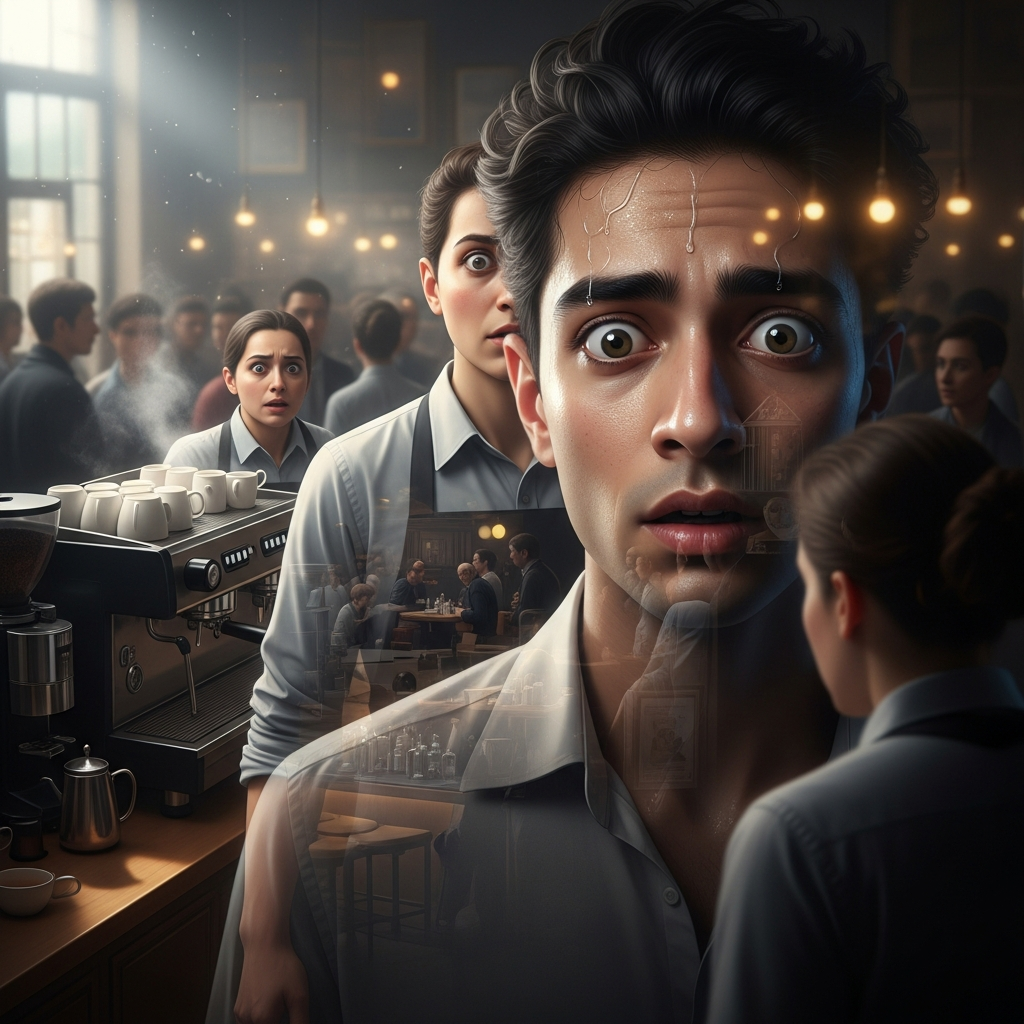
He fled his apartment, the stairs feeling like they were made of damp, unstable cardboard under his feet. He needed a voice, a witness, someone to speak the syllables that anchored him to the physical earth. He burst into the local café, the scent of roasted beans usually a comfort, now smelling like burnt, ancient paper. ‘Maya!’ he called out to the barista who had known him for five long years. She looked up, her eyes sliding over him as if he were a pane of clean glass. There was no recognition, no polite nod, not even the annoyance of a busy morning. He stood directly in front of her, the counter a barrier of polished, cold wood. ‘Maya, it’s me, Adesh,’ he whispered, his voice sounding thin and reedy in his own ears, like a distant radio signal. She blinked, looking through his forehead at the menu board behind him. ‘Can I help the next person in line?’ she asked, her voice a hollow, robotic monotone. Adesh turned around; there was no one behind him. He was a ghost in the midday sun. He reached out to touch the counter, but his fingers felt numb, the sensation of texture fading into a dull, static buzz. The patrons around him were blurred shapes, their conversations a low-frequency hum that carried no linguistic meaning. He tried to shout his name, to scream the vowels until his throat bled, but the air swallowed the sound before it could leave his lips. The world was withdrawing its consent for his existence. He was becoming a typographical error in the grand narrative of the city, a smudge on a page that the universe was determined to wipe clean.
Scene 3
The City of Mirror Signs
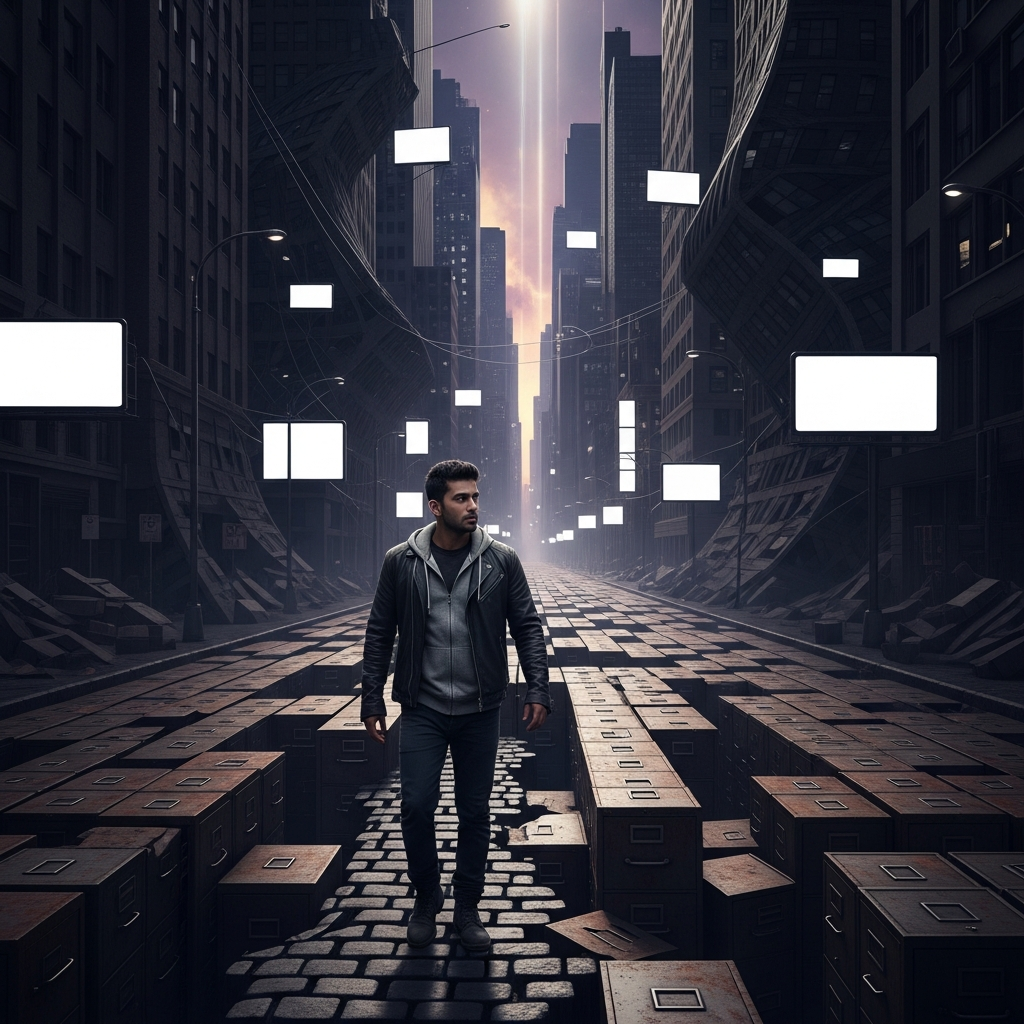
Adesh walked onto the street, but the city had transformed into a labyrinth of the unlabelled and the lost. The street signs were polished metal mirrors, reflecting nothing but the gray, oppressive sky. The storefronts had lost their logos; the familiar icons were now circles of nothingness. Even the license plates on the passing cars were blank, rattling like teeth in the wind. The sensory deprivation was overwhelming, a crushing weight of anonymity. He looked down at his hands and saw that his fingerprints were smoothing over, the unique swirls and ridges being ironed out by an invisible, cosmic pressure. A dog barked at a passerby, but as Adesh walked past, the animal fell silent and tucked its tail, sensing a hole in reality where a human being should be. He felt a sharp pulling sensation in his solar plexus, a gravitational tug toward the subway entrance. The darkness of the tunnel seemed more solid than the bleached-out world above. As he descended the stairs, the sound of the city faded into a rhythmic clicking, like a thousand typewriters clacking in unison in a vaulted hall. The air grew cold and smelled of old parchment and ozone. He realized then that he wasn’t just losing his name; he was being filed away. The architecture of the subway began to shift, the concrete walls turning into rows upon rows of dark wooden filing cabinets that stretched upward into a lightless, infinite abyss. He was no longer on a platform; he was in the guts of a cosmic archive, a place where the discarded and the forgotten were organized into a silence that lasted forever.
Scene 4
The Librarian of Ink
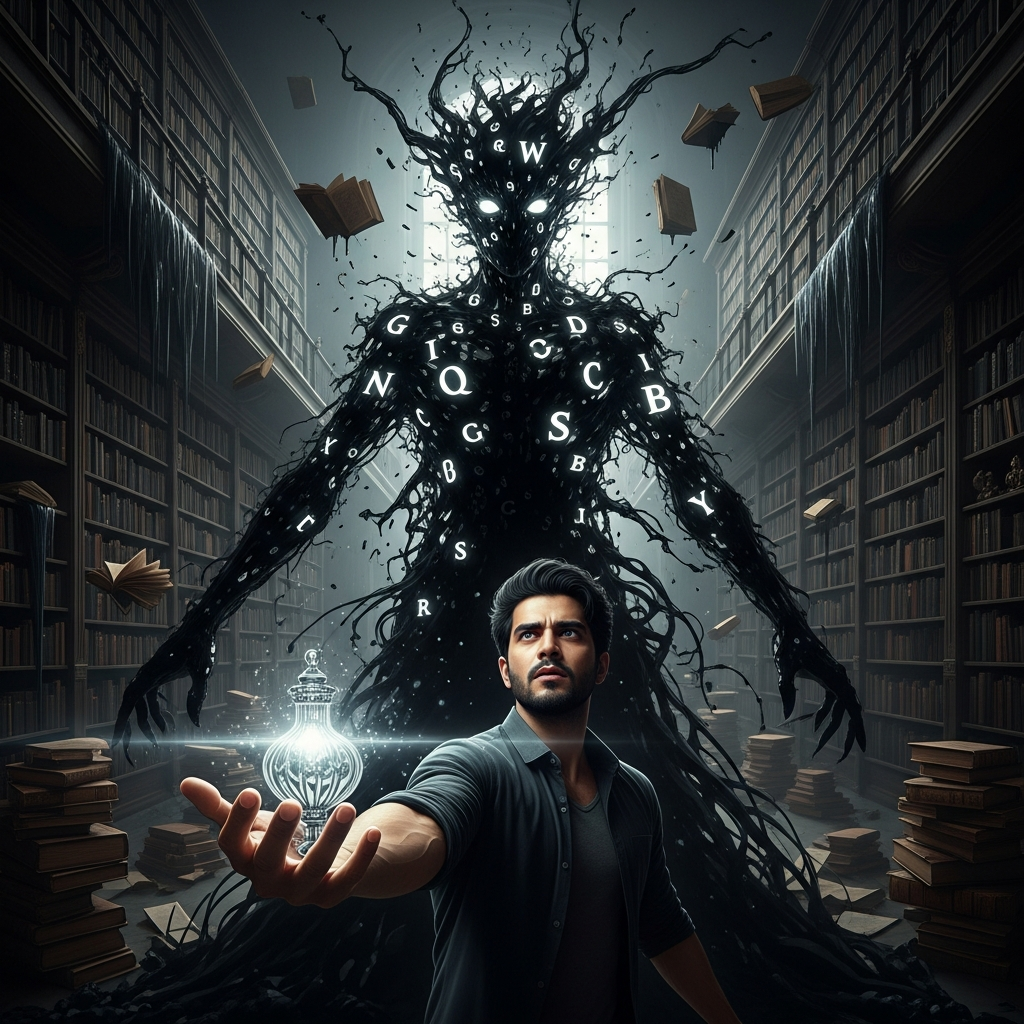
Deep within the subterranean labyrinth of the Archive of the Unnamed, Adesh encountered the Librarian. The entity did not have a body so much as a presence—a towering silhouette composed of shifting, liquid ink that dripped onto the floor without making a sound. It sat behind a desk carved from a single block of petrified, dark memory. Around its neck hung a heavy iron key, and its hands were long, spindly needles that danced over a massive, skin-bound ledger. Adesh tried to speak, but his voice was a mere vibration. The Librarian looked up, and where a face should have been, there was a swirling vortex of letters, a chaotic storm of ‘A’s, ‘D’s, ‘E’s, ‘S’s, and ‘H’s that refused to settle into his name. ‘You are early,’ the Librarian hissed, the sound like dry leaves skittering across a tombstone. ‘The deletion process is not yet complete. There is still a lingering scent of self on you.’ Adesh felt a surge of primal, desperate defiance. ‘My name,’ he gasped, fighting the numbness that threatened to turn his heart into a stone. ‘You took it.’ The Librarian chuckled, a wet, rattling sound that echoed in the void. ‘Names are not taken; they are surrendered. You lived a life of such quiet desperation, such suburban anonymity, that the universe simply forgot to keep you indexed. I am merely the janitor of the forgotten. I sweep up the spills of identity.’ The entity reached into a drawer and pulled out a small, glass vial. Inside, a silver vapor writhed—the last essence of Adesh Ingale, flickering like a dying candle in a gale.
Scene 5
The Hall of Redaction
Visual Synchronization Offline
The Librarian vanished into the shadows, leaving Adesh alone in the vast Hall of Redaction. The floor was carpeted in a thick, choking layer of shredded paper—the remnants of billions of lives, discarded like junk mail. Adesh began to run, his feet sinking into the pulp of lost histories. He reached an aisle labeled ‘I’ and began tearing through the drawers with a frantic energy. He saw files for ‘Ingram’, ‘Ingalls’, and ‘Inigo’, but the space for ‘Ingale’ was a gaping, physical tear in the wood, a portal into a crushing vacuum. He realized that the Archive wasn’t just a storage facility; it was a digestive system. The paper under his feet felt warm, vibrating with the residual energy of the people who had once claimed these names. He found a jar filled with the sound of a mother’s voice calling a child, another filled with the smell of a first rain in summer. He understood now that a name was the hook upon which all sensory experience was hung. Without it, the memories had no gravity; they simply floated away into the void. He saw a shadow moving at the end of the aisle—a distorted version of himself, a featureless mannequin made of gray smoke. It was his replacement, the ‘Nobody’ that would return to his apartment, sleep in his bed, and continue his life without ever being truly noticed. The shadow reached out for the vial the Librarian had left on the desk, its fingers elongated and hungry. Adesh knew that if the shadow consumed that vapor, the erasure would be permanent and absolute.
Scene 6
The Climax of Blood and Ink
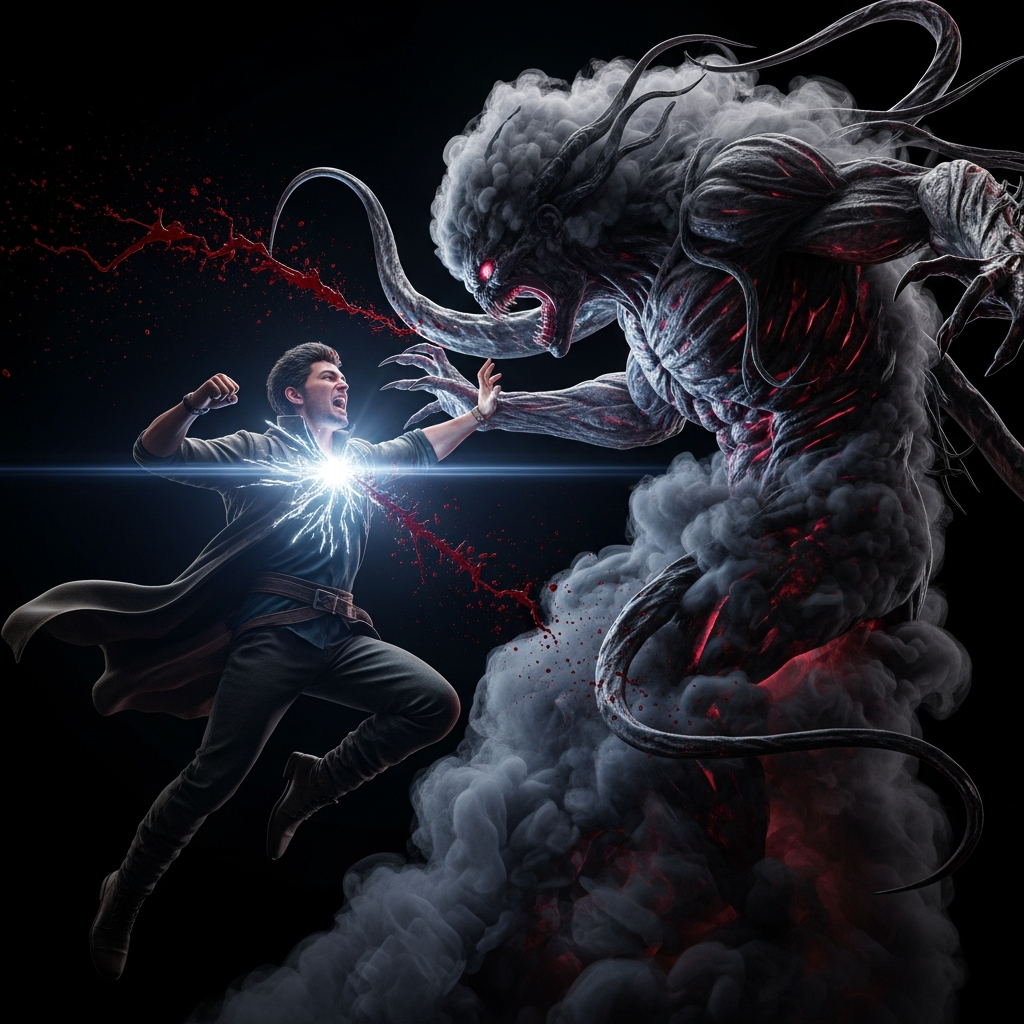
Adesh lunged at the shadow, his body feeling light and brittle, like a skeleton made of thin glass. They collided in a spray of ink and static. The shadow had no weight, but it possessed a terrifying, soul-deep coldness that seeped into Adesh’s marrow, turning his blood to slush. They grappled on the floor of the archive, tearing through files and scattering the names of the dead like autumn leaves. Adesh reached for the vial, his fingers brushing the cool glass, but the shadow slammed his hand down, its face—a flat, featureless plane—hovering inches from his own. ‘You are nothing,’ the shadow whispered, its voice a perfect, cruel mimicry of Adesh’s own internal monologue. ‘You are a ghost in your own life. Give up the ghost.’ Adesh felt his consciousness beginning to fragment into a thousand pieces. He saw flashes of his childhood, his first day of school, his father’s face, but the names associated with them were blurring, turning into unreadable smears of gray. In a final, desperate act of will, Adesh bit his own tongue until he tasted the copper tang of blood. He spat the red spray onto the shadow’s face. The blood, a vivid, living thing in this monochrome hell, acted like acid on the void. The shadow shrieked, a sound of tearing metal, and recoiled. Adesh grabbed the vial and smashed it against his chest. The silver vapor didn’t dissipate; it soaked into his skin, searing his flesh with the heat of a thousand suns. He began to scream his name, not as a word, but as a command to reality. ‘Adesh Ingale! Adesh Ingale!’ The archive began to tremble, the cabinets splintering under the weight of his rediscovered self.
Scene 7
The Permanent Mark

The world exploded in a kaleidoscope of color and sound. Adesh felt himself being pulled through a needle’s eye, the crushing pressure of the Archive giving way to the soft friction of cotton bedsheets. He gasped for air, his lungs burning as if he had been underwater for an eternity. He was back in his apartment. The pale, yellow light was gone, replaced by the warm, golden hue of a true morning. He scrambled out of bed and grabbed his phone. The screen was clear, and there, in crisp, digital letters, it said: ‘Welcome, Adesh.’ He ran to his desk and pulled out his wallet. His driver’s license sat in its leather slot, his face looking back at him, his name printed in bold, undeniable black ink. He walked to the mirror and wept. His features were sharp, his eyes bright with a newfound, terrifying clarity. He grabbed a pen from the desk—a simple, cheap ballpoint—and walked to the white wall of his bedroom. With a hand that did not shake, he carved his name deep into the drywall, the plaster crumbling under the tip. He wrote it over and over, a litany of existence, a scar on the world. He went out into the street, and the barista smiled at him. ‘The usual, Adesh?’ she asked. He nodded, the sound of his own name being spoken by another person feeling like a holy benediction. He was no longer a smudge or a typo. He was a story written in permanent ink, a man who had stared into the void and demanded to be read. The world was loud, messy, and full of names, and he finally knew exactly where his belonged.