Scene 1
The Ozone Awakening
Adesh Ingale’s eyes snapped open to the jarring, rhythmic chirp of an alarm that should have been silent. The air in his bedroom felt unnaturally thick, tasting of ozone and the metallic tang of old pennies. As his vision cleared, the first thing he noticed was the digital clock on the bedside table. It glowed with a sickly green luminescence, displaying October 14th—the day he had just lived through, a Tuesday that had been unremarkable until now. The sunlight filtering through the blinds hit the floor at the exact same sharp angle he remembered from twenty-four hours ago, illuminating the same dust motes dancing in the stagnant air. A cold, visceral dread pooled in his stomach. He reached for his phone, but the screen was a frozen image of a text message he had received yesterday morning. When he stood, his joints felt stiff, as if his body were protesting the impossibility of the moment. He walked to the kitchen, his bare feet sticking slightly to the linoleum. On the counter sat a half-consumed cup of coffee, the steam rising in a perfect, unmoving spiral, frozen in time like a glass sculpture. Adesh reached out to touch the ceramic, and the moment he made contact, the steam dissipated into a cloud of gray ash. The silence of the house was absolute, a heavy, pressurized void that pressed against his eardrums. He realized with a jolt of terror that the world outside was not waking up; it was merely repeating the ghost of its previous existence, and he was the only witness to the glitch.
Scene 2
The Staccato Street
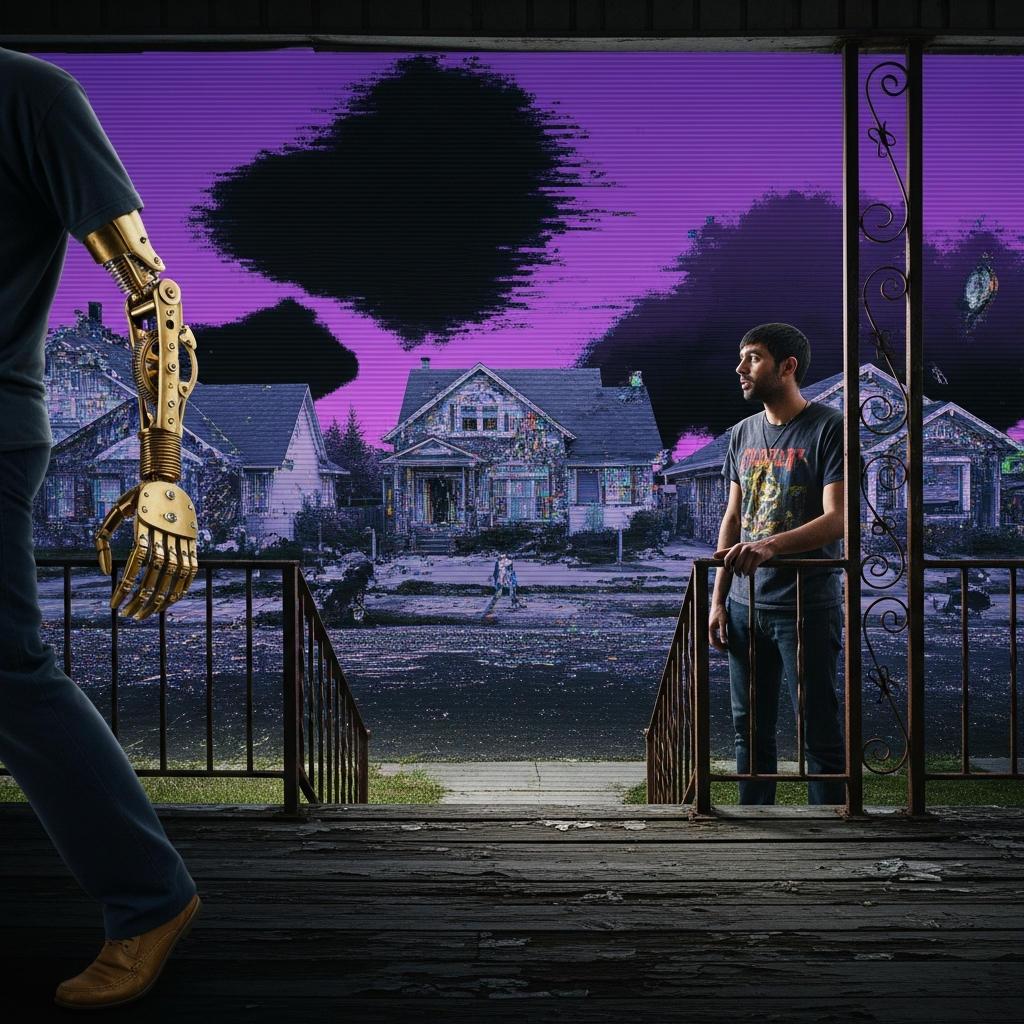
Adesh stepped onto his porch, and the world greeted him with a cacophony of distorted echoes. The street was a grotesque pantomime of yesterday’s routine. His neighbor, Mr. Henderson, stood by the mailbox, but his movements were staccato and jagged, like a film reel missing every third frame. Mr. Henderson’s arm swung upward to wave, but as it reached the apex, the skin began to peel back, revealing a lattice of rusted gears and twitching clockwork underneath. Adesh tried to call out, but his voice was caught in a feedback loop, his own words from yesterday’s grocery list spilling out of his mouth in a frantic, garbled whisper. The sky above was not blue; it was a bruised, shifting violet, streaked with veins of black static that hummed with a low-frequency vibration that rattled his teeth. A child rode a bicycle past him, but the wheels didn’t turn; they slid across the pavement, leaving trails of liquid shadow. The child’s face was a featureless mask of smooth, pale skin, save for a single, oversized eye in the center of the forehead that blinked in synchronization with the ticking of an invisible clock. Adesh realized that the physics of ‘Yesterday’ were decaying. The further he moved from his front door, the more the reality around him frayed at the edges. Trees didn’t sway; they flickered in and out of existence, replaced momentarily by pillars of charred bone before snapping back to wood. He was trapped in a dying memory, a celestial scrap-heap of a day that was being digested by something vast and hungry.
Scene 3
The Recursive Park
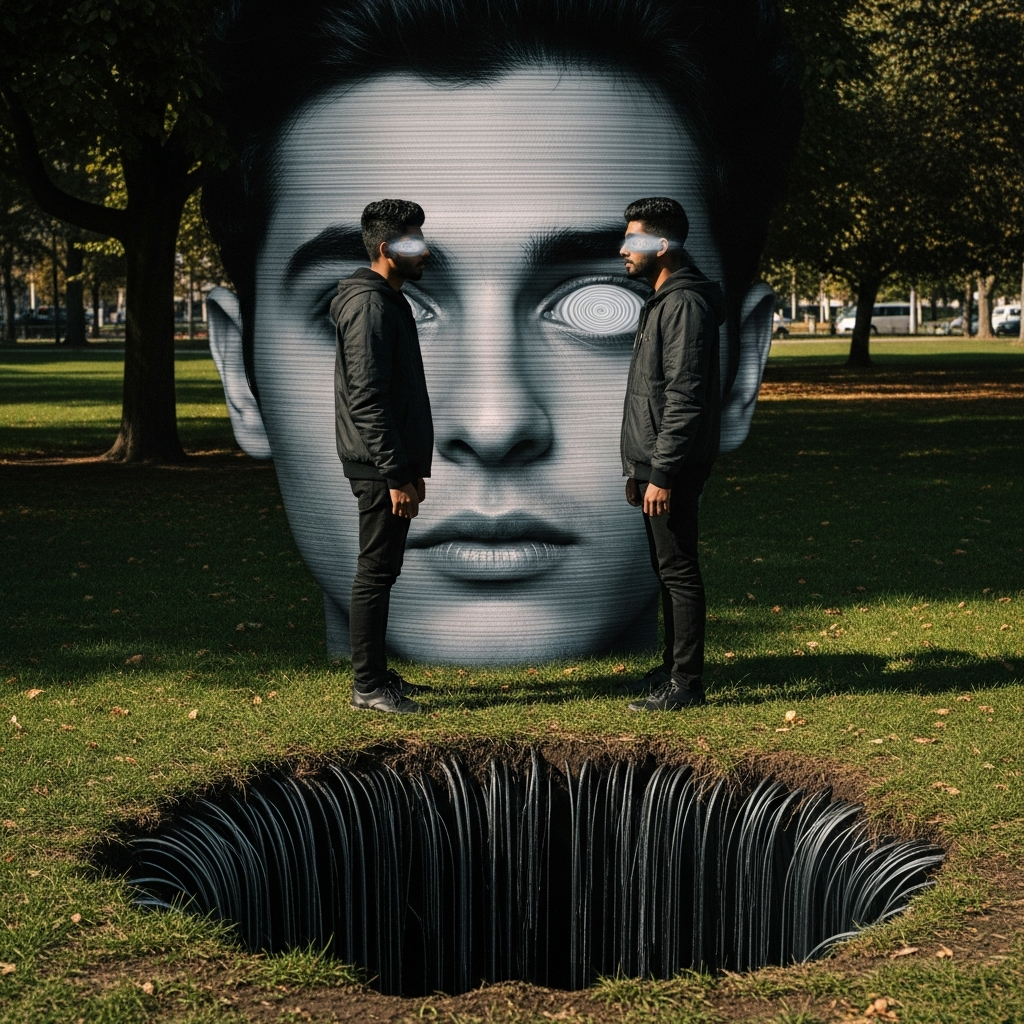
Seeking answers, Adesh hurried toward the city park, the only place where he felt the spatial density might be thin enough to break. Instead, he found the impossible. Sitting on a park bench, bathed in a pool of artificial-looking light, was another version of himself. The ‘Other Adesh’ wore the same charcoal hoodie and frayed jeans, but his posture was slumped, defeated. As Adesh approached, the air between them began to warp, swirling like oil on water. The Other Adesh turned his head, and Adesh’s heart nearly stopped. Where eyes should have been, there were two swirling vortices of white noise, emitting the static sound of a dead television channel. The doppelganger opened its mouth to speak, and the sound that emerged was a symphony of breaking glass. ‘You shouldn’t have come back to find yourself,’ the creature vibrated. The ground beneath their feet turned translucent, revealing a recursive abyss of yesterday after yesterday, layered like the skins of an onion. Adesh felt a physical pull, a gravitational hunger drawing him toward his double. He realized that they were two ends of a temporal circuit, and the moment they touched, the loop would close forever, erasing his existence into a permanent ‘then.’ He scrambled backward, but the park benches were elongating into claws, reaching for him. The sensory overload was agonizing—the smell of rotting lilies mixed with the scent of burnt rubber, while his vision began to split into a kaleidoscopic fractured view of his own past, each fragment a different moment of his own terror.
Scene 4
Architecture of Regret

The city began to undergo a rapid, horrific transformation. Skyscrapers didn’t just crumble; they melted, the concrete turning into a viscous, gray fluid that smelled of old funeral parlors. Adesh ran through the downtown district, but the streets were no longer paved with asphalt; they were lined with millions of discarded photographs of his own life, all depicting moments he had forgotten. Each step he took crunched through his own history. The wind began to pick up, carrying with it the voices of everyone he had ever spoken to, all screaming their lines from yesterday in a terrifying, discordant chorus. He looked up to see the sun, but it had been replaced by a massive, ticking iris that watched his every move. The hands of a giant, invisible clock swept through the air like scythes, slicing through the buildings and leaving behind trails of iridescent mist. Adesh dodged a falling clock hand that missed him by inches, the blade humming with a frequency that made his nose bleed. He saw his mother standing at a crosswalk, her form blurring and stretching like taffy. He tried to grab her hand, but his fingers passed through her as if she were made of smoke and regret. The world was no longer a place of matter; it was a realm of pure, agonizing sentiment, where the laws of physics were replaced by the logic of a nightmare. He had to find the source of the distortion before the entire concept of ‘Adesh’ was dissolved into the atmospheric sludge of a discarded Tuesday.
Scene 5
The Chronophagist’s Feast
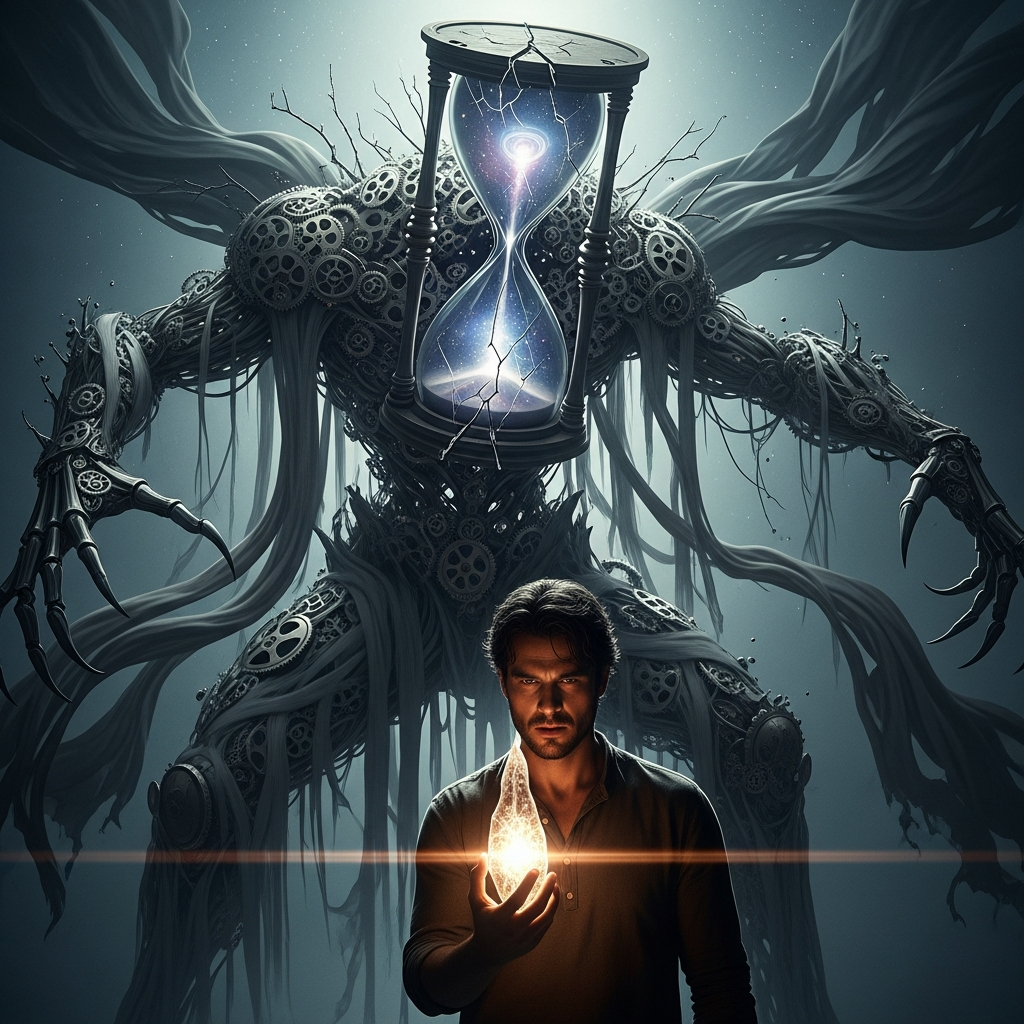
At the epicenter of the temporal collapse stood a figure that defied the limits of human comprehension. It was the Chronophagist, a gargantuan entity woven from the discarded moments of a thousand dead yesterdays. Its body was a shifting mass of rusted gears, tattered silk, and translucent limbs that plucked stars from the sky like ripened fruit. It stood over the wreckage of the town square, its head a colossal hourglass filled with human ash instead of sand. As Adesh approached, the creature turned its gaze upon him, and the weight of a million years pressed down on his shoulders. The Chronophagist didn’t speak in words; it radiated a cold, ancient hunger that echoed in the marrow of Adesh’s bones. ‘You are the anomaly,’ the thought vibrated in his mind. ‘The one who refused to be forgotten.’ The entity reached out a hand made of shadow and ticking needles, attempting to sew Adesh into the tapestry of the past. Adesh felt his skin beginning to turn into parchment, his blood slowing into ink. He saw the ‘Mirror of Tomorrow’ lying shattered at the creature’s feet—a fragment of the future that had been broken during the transition. He realized that the only way to defeat a god of time was to introduce an element of pure chaos. He lunged forward, ignoring the way his muscles tore like wet paper, and grabbed a jagged shard of the future. The shard glowed with a blinding, white light that burned through the gloom of the perpetual yesterday, a beacon of hope in a graveyard of time.
Scene 6
The Shattered Cycle
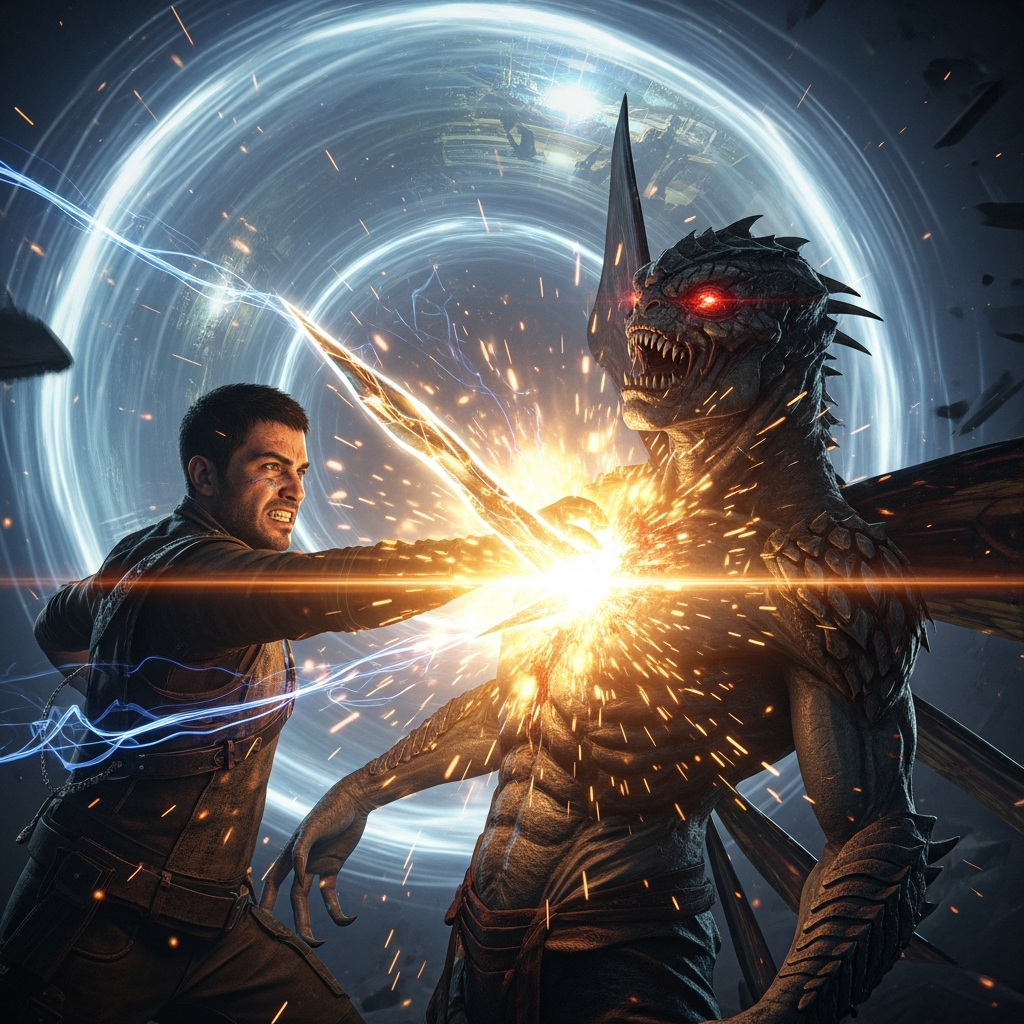
The confrontation was not a battle of strength, but a struggle of willpower. Adesh plunged the shard of the future into the heart of the Chronophagist. The reaction was instantaneous and violent. The entity’s scream was the sound of a billion clocks shattering simultaneously, a frequency so high it shattered the nearby buildings into dust. Reality began to invert. Adesh was pulled into a psychic vortex where he was forced to relive his most painful memories in a searing loop—the death of a childhood pet, his first heartbreak, the crushing weight of his failures. The Chronophagist tried to use these memories as anchors, dragging him back into the sludge of the past. ‘Stay here!’ the entity roared through the static. ‘In the past, you are known! In the future, you are nothing!’ Adesh screamed back, his voice finally breaking through the temporal dampening. ‘I would rather be nothing than a ghost!’ He twisted the shard deeper, and the creature’s body began to unravel into threads of golden light. The sky tore open, revealing a terrifying void beyond the stars. Adesh felt himself being pulled apart, his physical form disintegrating into pure energy. He was no longer a man; he was a bridge between what was and what could be. The pressure was immense, threatening to extinguish his consciousness, but he held onto the single thought of ‘Tomorrow’ until his very soul glowed with the heat of a dying sun, incinerating the loop once and for all.
Scene 7
The Price of Tomorrow

Adesh Ingale woke up to the sound of birds—real, chaotic, unscripted birds. He was back in his bed, but the room felt different. The light was pale and new, the light of an October 16th that had never been lived before. He sat up, his body feeling heavy and ancient. When he looked at his hands, they were covered in a fine layer of silver dust that refused to wash off. He walked to the bathroom and stared into the mirror. The man looking back at him had streaks of white in his hair and eyes that had seen the beginning and end of time. His shadow, however, did not follow his movements; it remained frozen in the doorway, a dark silhouette of the man he used to be, forever trapped in the memory of the day before. He checked his phone. No messages. No echoes. The silence was no longer heavy; it was empty, a blank canvas. He walked to the window and looked out at a world that was moving forward, messy and unpredictable. He had escaped the loop, but he had paid for his future with the essence of his past. On the bedside table, the digital clock clicked forward to 7:01 AM. He was free, but he was a stranger in his own life, a survivor of a war that no one else knew had happened. The smell of ozone lingered faintly, a reminder that ‘Yesterday’ was always just a heartbeat away, waiting for the clock to glitch once more, leaving him to wonder if he was truly home.