Scene 1
The Uncharted Threshold
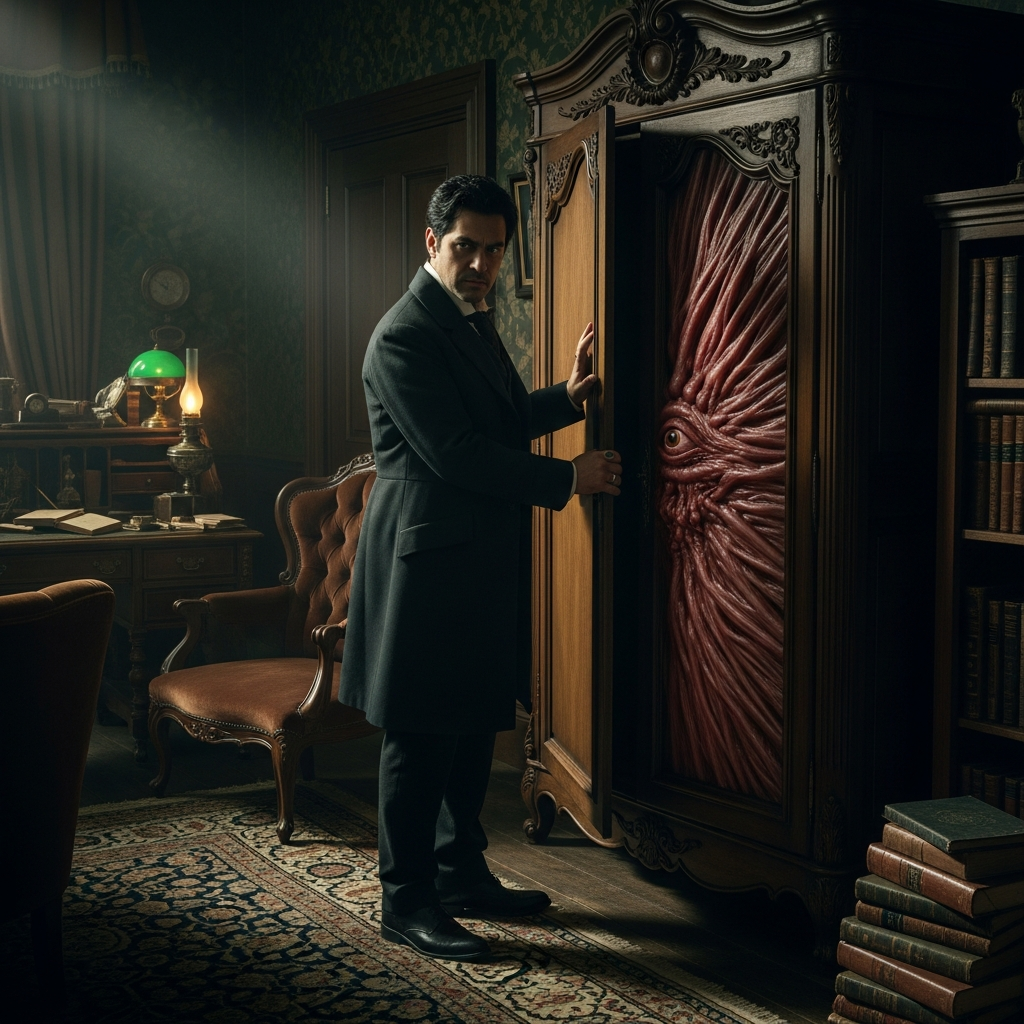
Adesh Ingale stood in the center of his new, suspiciously affordable apartment in the old quarter of Mumbai. The humidity hung heavy, smelling of salt and copper. Behind a massive mahogany wardrobe that took three men to move, he found it: a door that shouldn’t exist according to the building’s blueprints. It was narrow, framed in dark, porous wood that felt unnervingly warm to the touch. The surface wasn’t flat; it had a subtle, rhythmic curve, like the side of a sleeping beast. Adesh ran his fingers over the grain, noticing that the wood felt less like cellulose and more like cured leather. As he reached for the brass handle, which was shaped like a coiled serpent, the entire frame shuddered. A low, wet sound, like a boot pulling out of thick mud, echoed through the empty room. Adesh recoiled, his heart hammering against his ribs. The air in the room suddenly turned cold, and the dust motes seemed to freeze mid-air. He stared at the door, and for a fleeting second, the horizontal line of the doorframe seemed to curve upward, mimicking a brow. He dismissed it as a trick of the flickering overhead light, a symptom of exhaustion from the move. But as he turned away, he heard the distinct, fleshy slap of a heavy eyelid closing and opening. He whirled back, but the door was still, though the brass handle was now wet with a clear, viscous fluid that hadn’t been there a moment ago. Adesh knew then that he hadn’t just moved into a home; he had moved into a creature.
Scene 2
The First Gaze
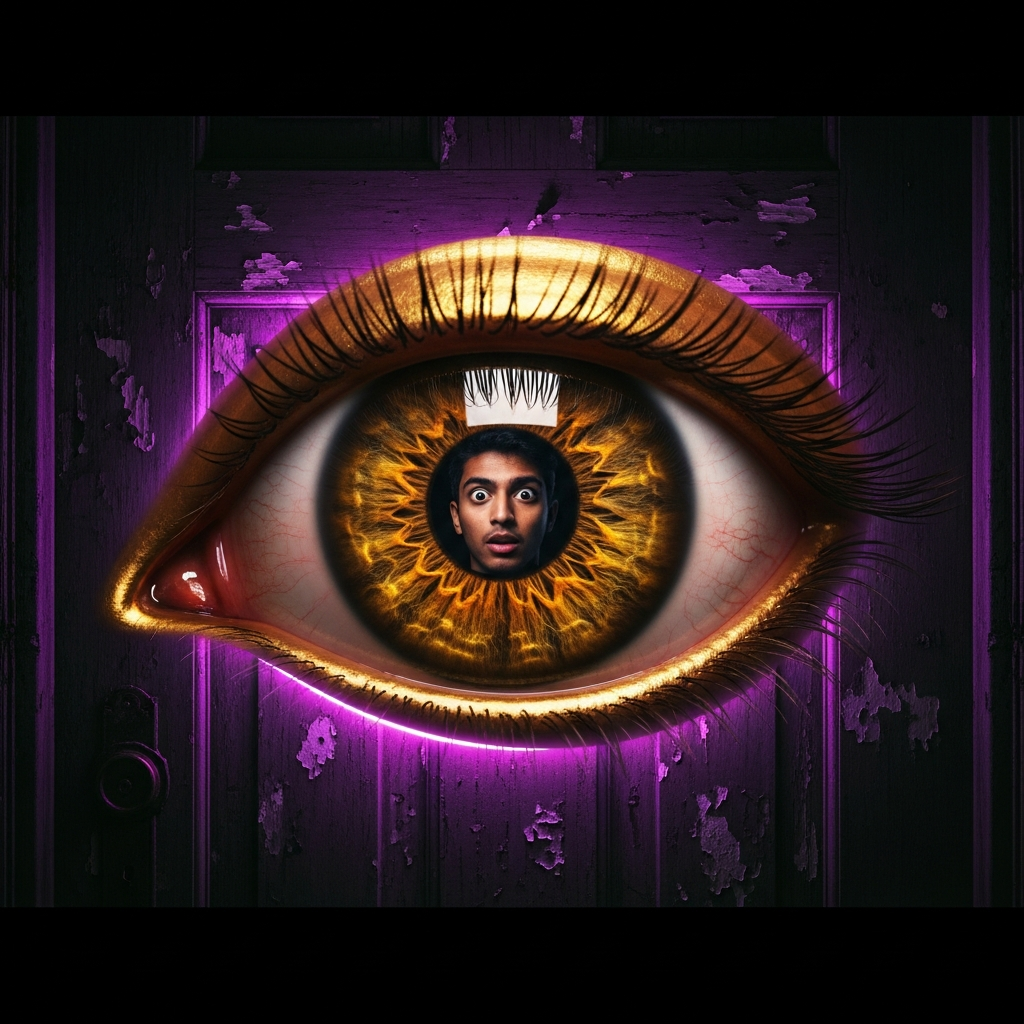
Sleep was an impossibility for Adesh. He sat in a velvet armchair, a flashlight clutched in his trembling hand, aimed directly at the mysterious portal. At 3:33 AM, the reality of the apartment began to liquefy. The shadows on the walls stretched into long, spindly fingers that didn’t match the furniture casting them. Suddenly, the door didn’t just move; it blinked. A massive, translucent membrane swept down from the top of the frame, coating the wood in a shimmering sheen of vitreous humor. Below the membrane, a giant, golden iris manifested, occupying the entire upper half of the door. The pupil was a vertical slit, pulsing with a deep, violet light. Adesh felt a psychic weight press down on him, a gaze that didn’t just see his skin, but peeled back the layers of his memories. He tried to scream, but his voice was caught in his throat, muffled by the sudden thickening of the air. The room began to tilt. The floorboards beneath his feet felt like a tongue, soft and slightly damp. The door-eye rolled upward, looking into the ceiling as if searching for something in the floor above. Adesh realized with a jolt of pure terror that the house wasn’t built around the door; the door was the sensory organ of a much larger, subterranean entity, and he was currently sitting inside its mouth. The iris settled back on him, Dilating with an predatory curiosity. Adesh gripped the arms of his chair, watching as the walls began to sweat a dark, crimson sap that smelled of old books and dried blood.
Scene 3
The Anatomy of Architecture
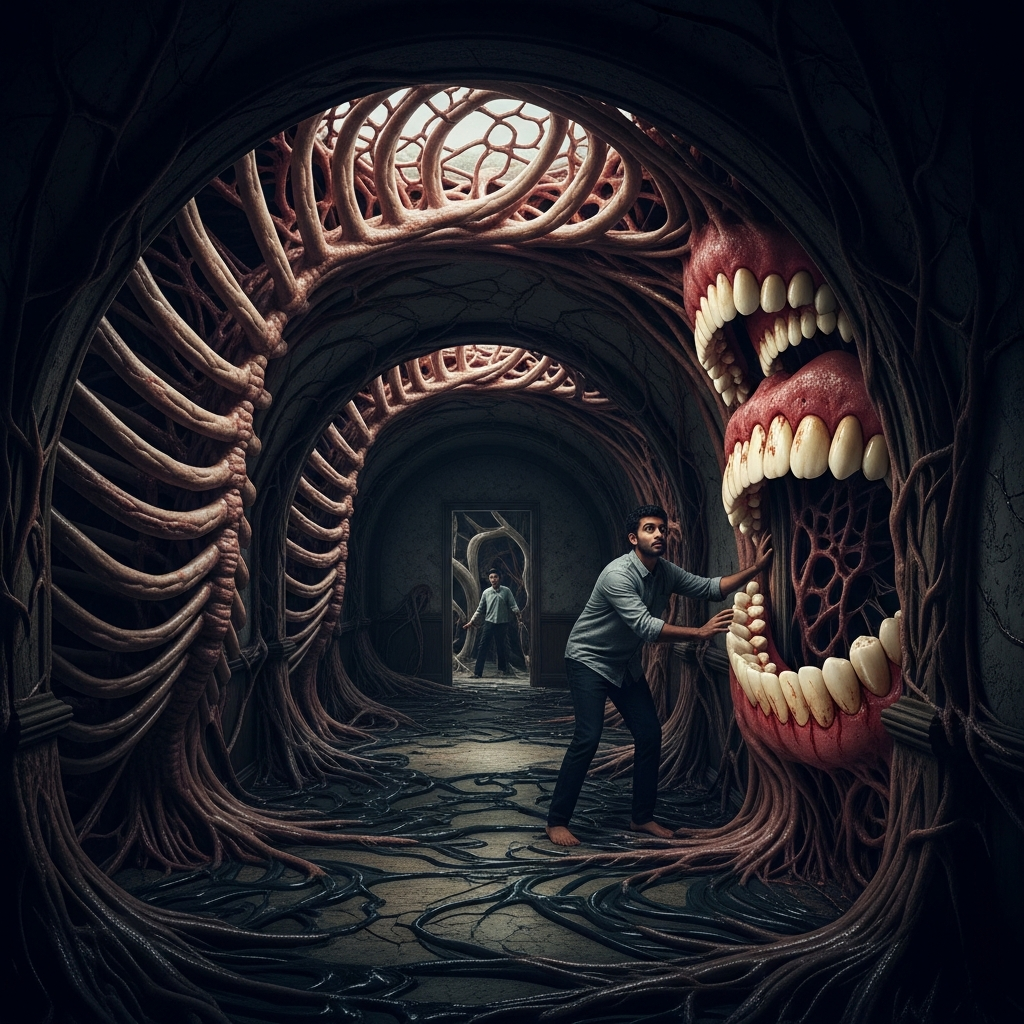
By the third day, the transformation of the apartment was nearly complete. Adesh Ingale no longer recognized the hallway. The plaster had fallen away to reveal pulsing, muscular red pipes that served as veins, pumping a glowing blue ichor throughout the structure. The door—the Eye—watched his every move. Whenever Adesh tried to approach the exit to the street, the hallway would elongate, stretching into an infinite perspective of rib-like arches. He was a prisoner in a biological labyrinth. He found that if he spoke, the walls would vibrate in harmony with his vocal cords. Desperate for answers, he began to peel back the ‘wallpaper,’ which now felt like shedding skin. Beneath it, he found rows of calcified teeth embedded in the lath and plaster. The door blinked again, faster this time, a rhythmic strobe effect that made Adesh’s movements look like a disjointed stop-motion film. He noticed that the door was crying; a thick, black ink-like substance leaked from the corners of the frame, pooling on the floor and forming Rorschach patterns that moved on their own. Adesh knelt by the pool, and as he stared into the blackness, he saw visions of the city outside—but it wasn’t the Mumbai he knew. It was a city of bone and glass, viewed through the eyes of a thousand different doors. He realized the entity was a nexus, a watcher of all realities, and it had chosen him to be its new primary observer. The door creaked open an inch, revealing not a room, but a vast, starry void that smelled of ozone and ancient stone.
Scene 4
The Memory Harvest
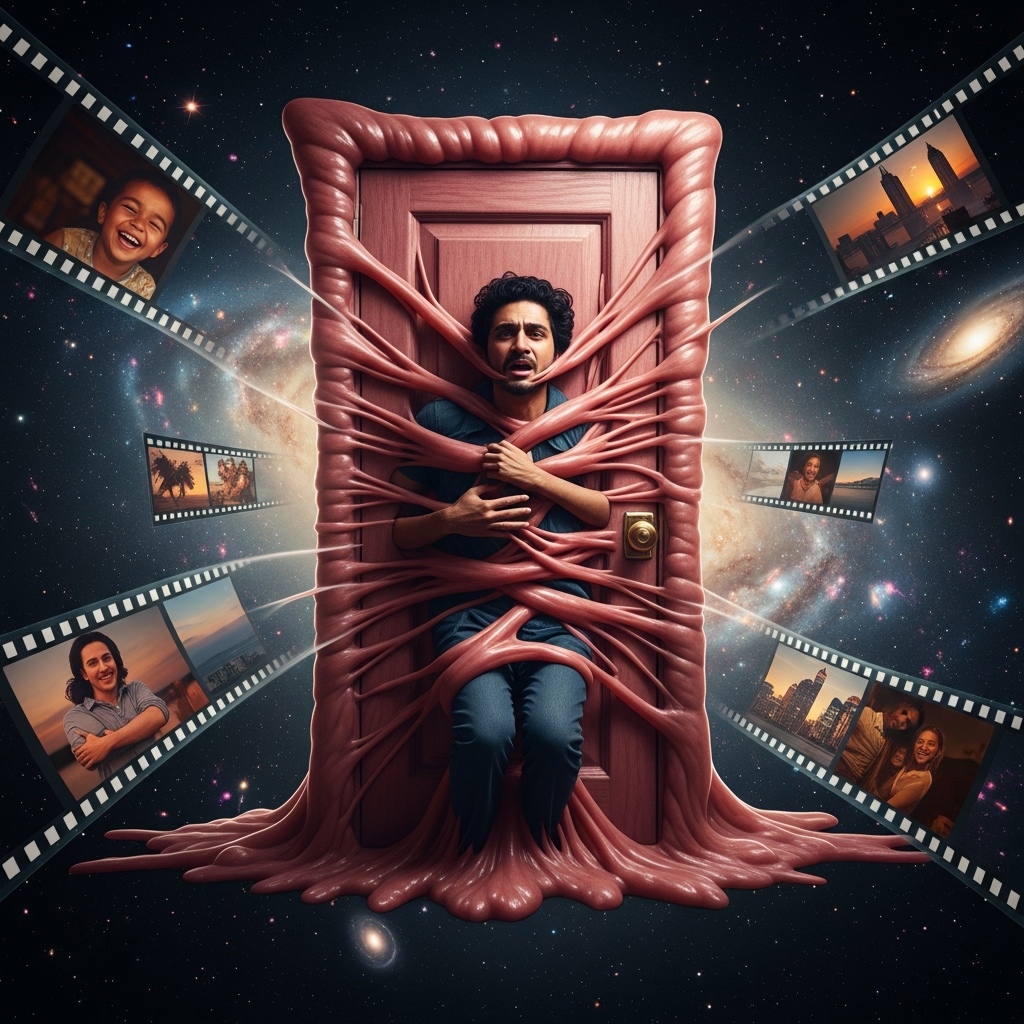
The door began to speak, not in words, but in a series of rapid-fire blinks that projected images directly into Adesh’s mind. He saw his childhood, his first love, and his greatest failures, all being played back with a distorted, nightmarish filter. Each time the door blinked, a part of Adesh’s identity felt like it was being vacuumed out. His reflection in the hallway mirror began to fade, the features of his face blurring into a smooth, featureless surface. Adesh Ingale fought back. He grabbed a shard of broken mirror, using it as a weapon of self-perception. He shouted his name into the fleshy abyss of the kitchen, demanding his life back. The house responded with a violent convulsion. The floor buckled, throwing him toward the blinking door. As he collided with the wood, he didn’t hit a hard surface; he sank into it like quicksand. The wood was cold, like ice, and he could feel the giant iris pressing against his chest. The heartbeat of the house was deafening now, a rhythmic thumping that shook the very foundations of the street outside. He realized the door wasn’t just eating his memories; it was recording them, archiving his soul into a cosmic library of suffering. He saw other ‘doors’ in his mind’s eye, thousands of them across the globe, all blinking in a synchronized, terrifying heartbeat. He was becoming a data point in a hive mind of architectural predators. He bit his lip until it bled, the sharp sting of pain anchoring him to the physical world, preventing his consciousness from being fully absorbed into the optic void of the threshold.
Scene 5
The Blinding Ritual
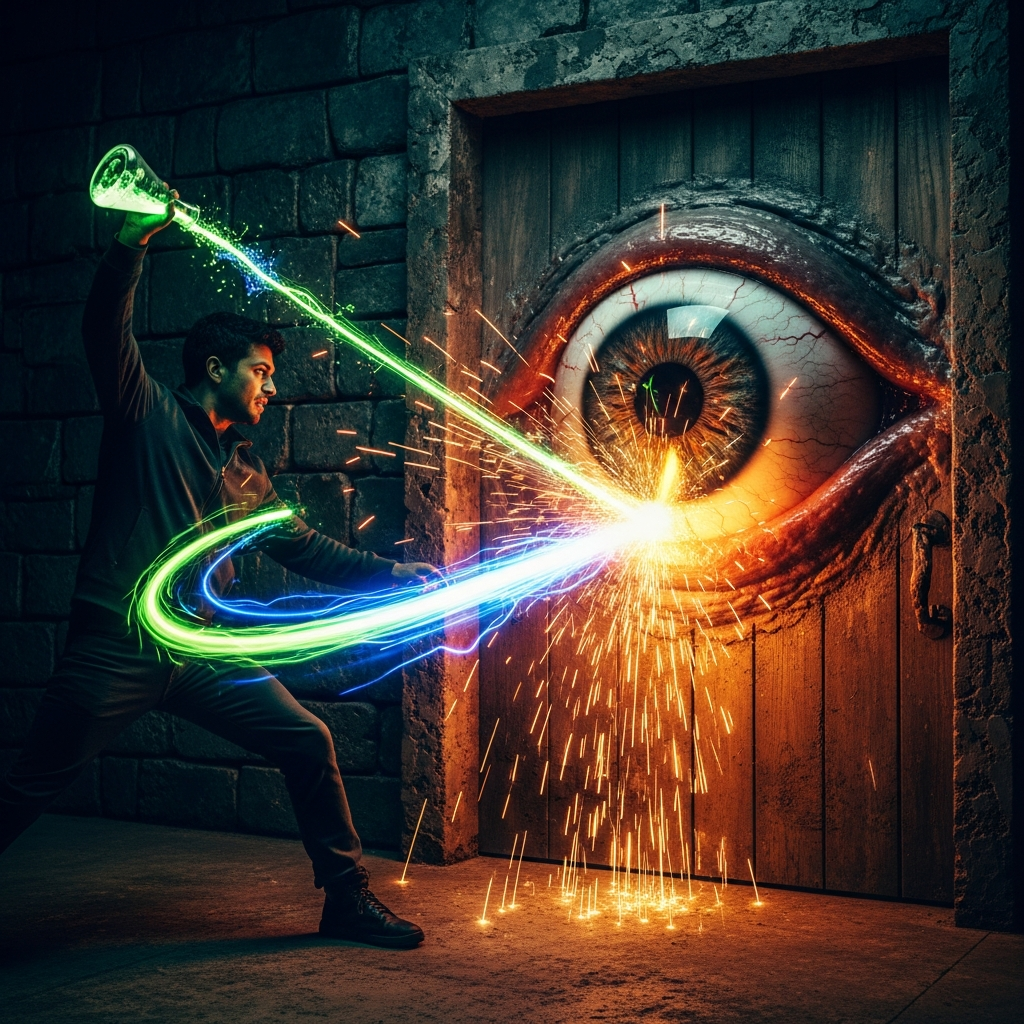
Adesh knew that to survive, he had to blind the watcher. He gathered the remaining cleaning chemicals from under the sink—ammonia and bleach—and mixed them with the black ink leaking from the door’s ‘tears.’ The mixture hissed and bubbled, emitting a foul, caustic vapor. Adesh Ingale approached the door, his eyes watering from the fumes. The door seemed to sense his intent; the iris contracted until it was a needle-thin line of light. The room began to spin, the gravity shifting so that Adesh was walking on the ceiling. He clung to a light fixture, his knuckles white. The door began to blink frantically, trying to disorient him with a barrage of horrific images: his own death in a thousand different ways. But Adesh closed his own eyes. If he couldn’t see the terror, it lost its power over his physical form. Navigating by touch and the sound of the door’s wet blinking, he crawled toward the frame. He reached out and splashed the caustic mixture directly onto the golden iris. A sound like a thousand glass flutes shattering erupted through the house. The door let out a high-pitched, subsonic scream that cracked the windows and sent Adesh tumbling to the floor. The golden light turned into a muddy, bruised purple. The lid slammed shut, and the house groaned in agony. The muscular walls thrashed, and for a moment, the front door to the street appeared, flickering in and out of existence. This was his only chance to escape the digestive tract of the living building.
Scene 6
Into the Pupil
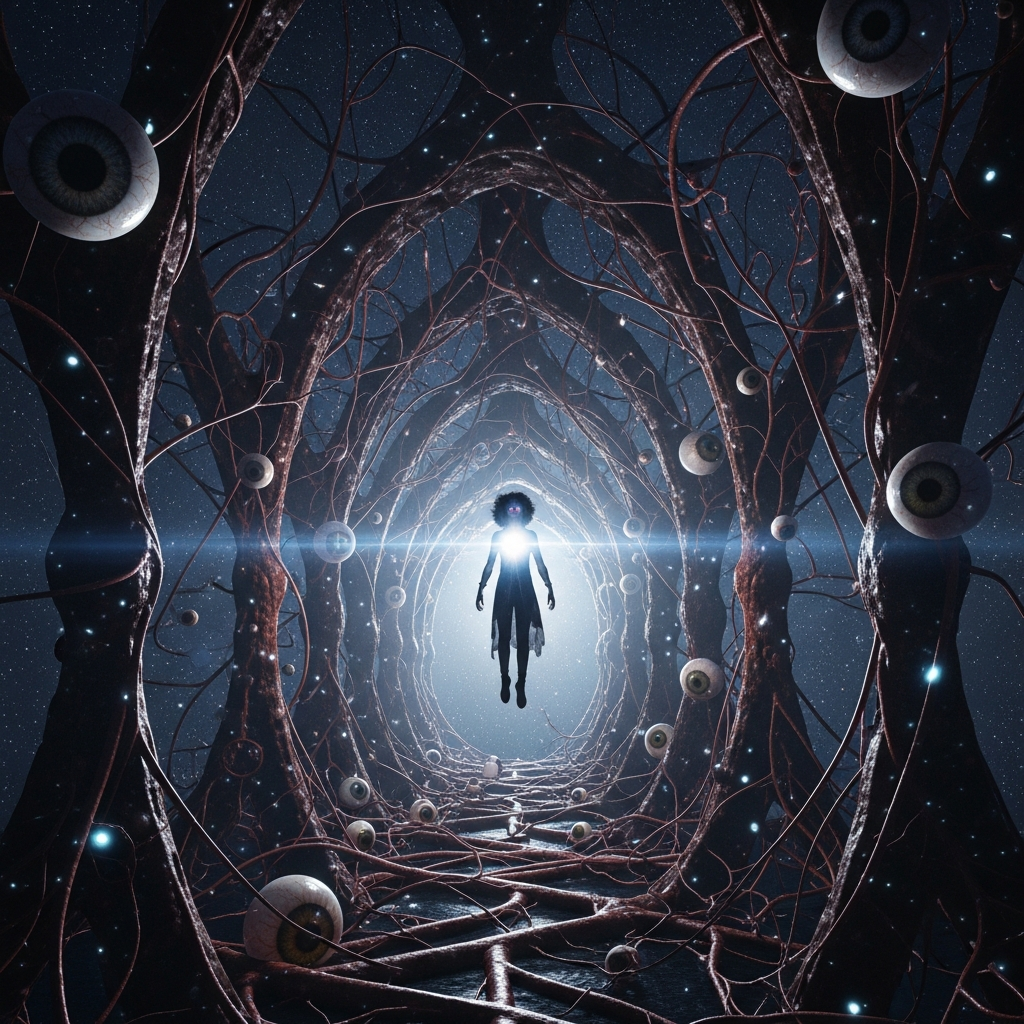
Escape was a lie. As Adesh Ingale reached for the front door, it dissolved into a wall of thousands of tiny, blinking eyes. There was no way out, only a way through. The main door, the one he had blinded, didn’t stay shut. It tore open, the ‘wood’ splitting like a wound. Inside was not the void he had seen before, but the internal anatomy of the cosmic entity. It was a cathedral of nerves and light. Adesh realized that the blinding ritual hadn’t killed the eye; it had forced it to look inward. He stepped into the iris, his body becoming weightless. He was floating in a sea of vitreous humor, surrounded by the thoughts and dreams of everyone who had ever lived in this house. He saw their ghosts, translucent and weeping, woven into the optic nerves like flies in a spiderweb. Adesh reached out and touched a nerve, and suddenly he saw through the eyes of a cat in Istanbul, a baker in Paris, and a child in Tokyo. All were being watched by their own ‘blinking doors.’ The horror was universal. He wasn’t just Adesh Ingale anymore; he was a witness to the global surveillance of a trans-dimensional parasite. The center of the pupil was a white hole of pure information. He knew that if he reached it, he could overwrite the signal. He swam through the gelatinous air, his movements fluid and desperate. The house roared around him, the sound of a god realizing its prey had found the control room. He reached the center, a sphere of pure, blinding white light, and plunged his hands into the core of the entity’s consciousness.
Scene 7
The New Watcher
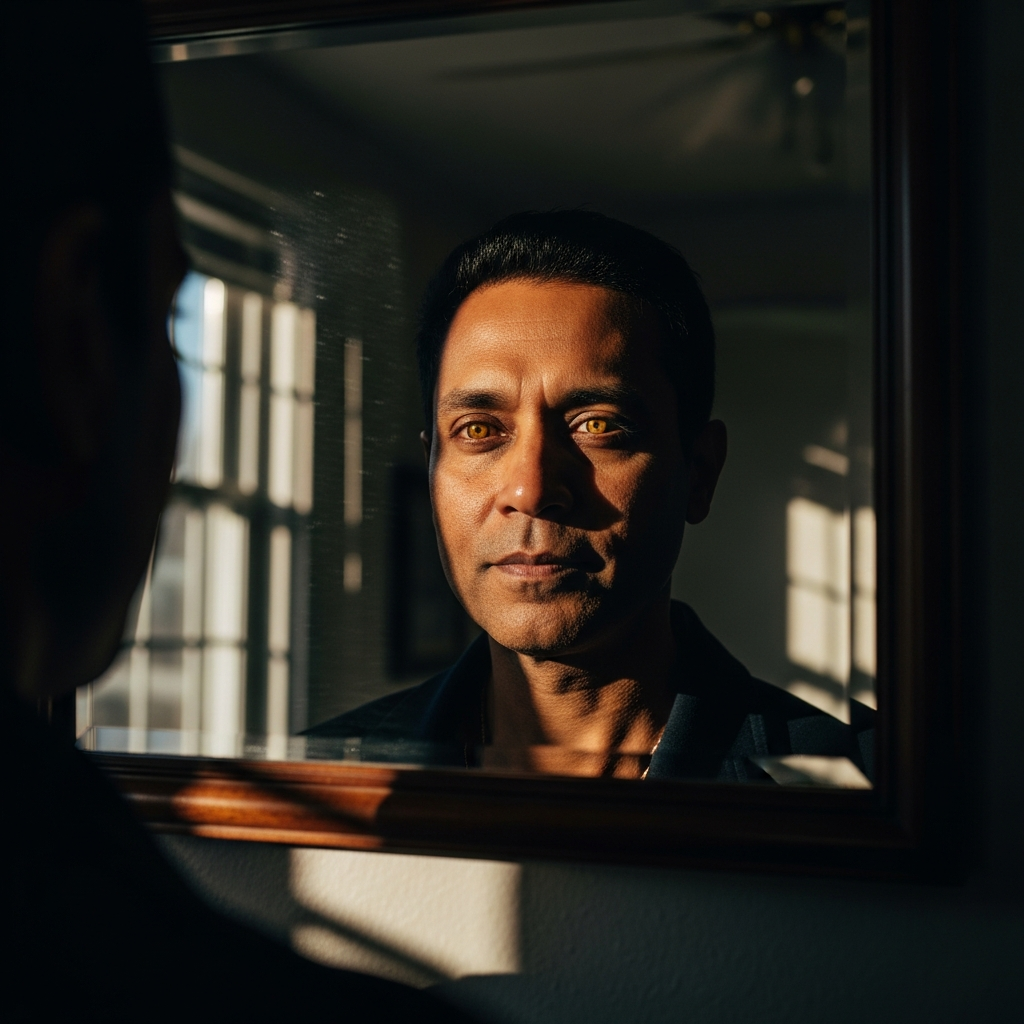
The explosion was silent. When Adesh Ingale opened his eyes, he was lying on the hard wood floor of an empty apartment. The sun was rising over Mumbai, casting long, orange fingers across the dusty room. The mahogany wardrobe was gone. The walls were just plaster and lath. There was no trace of the veins, the teeth, or the blood. He stood up, his limbs feeling heavy and strange. He walked to the place where the door had been. There was only a blank wall, scarred with the faint rectangular outline of a frame that had long since been removed. Adesh felt a strange sensation in his own face. He walked to the bathroom and looked in the mirror. His eyes were no longer brown. They were golden, with vertical slit pupils that pulsed with a faint violet light. He didn’t blink. He realized he didn’t need to anymore. He could see through the walls, through the city, into the very fabric of the world. He saw the other doors—the thousands of them—and he realized they were now all under his gaze. He hadn’t just escaped the entity; he had usurped it. He was the Door That Blinked. He walked to the window and looked out at the waking city. As he watched a neighbor across the street open their front door, Adesh smiled. He reached out and, with a simple thought, made the neighbor’s door blink. The cycle had not ended; it had simply found a new, more human master. Adesh Ingale was no longer a restorer of artifacts; he was the restorer of the unseen world, the eternal observer of the blinking threshold.