Scene 1
The Threshold of Amnesia

Adesh Ingale stood before the wrought-iron gates of the Malhar Estate, his boots crunching on gravel that sounded like breaking bone. The house, a monolithic structure of Victorian masonry and weathered teak, loomed against a sky the color of a fresh bruise. It had been twenty years since he last stood here, yet the structure felt fundamentally alien, as if the dimensions had been recalibrated in his absence. The ivy clinging to the walls didn’t just grow; it throttled the stone, its dark leaves shivering despite the lack of wind. Adesh felt a cold sweat prickle his neck. He reached for the brass knocker, but his hand froze; the metal was warm, pulsating with a slow, rhythmic thrumming that felt like a heartbeat. He pushed the door open, the hinges screaming a protest that sounded eerily like a human name. Inside, the air was thick with the scent of dust and something metallic—like blood or old copper coins. The shadows in the corners were too deep, too hungry, stretching toward him as if trying to recognize his scent. ‘I’m home,’ he whispered, but the words felt hollow, swallowed by the oppressive silence of the foyer. The grandfather clock in the hall began to chime, but instead of a bell, it produced a wet, thudding sound. Adesh realized then that the house wasn’t just empty; it was waiting. It didn’t recognize its master. The walls seemed to lean in, whispering secrets in a language he had forgotten, a dialect of rot and abandonment. He was a trespasser in his own legacy, a ghost in a machine of wood and wire that had decided to delete his existence from its memory.
Scene 2
The Erasure of Evidence

As Adesh Ingale moved deeper into the parlor, he approached the ‘Wall of Ancestors.’ His heart hammered against his ribs like a trapped bird. He expected to see the familiar faces of his parents, his grandparents, and himself as a wide-eyed child. Instead, he found a gallery of nightmares. The ornate silver frames held canvases that were once vibrant, but now, they were smears of grey and charcoal. In the center, where his own portrait had hung, there was nothing but a jagged hole in the reality of the paper. It wasn’t just torn; the pigment had been scrubbed away by something unseen. Adesh reached out to touch the frame, and as his fingers grazed the wood, he felt a sharp, stinging sensation. His vision blurred. When his sight returned, he looked down at his own hand. His wedding ring, a solid band of gold, was fading, turning into a translucent mist before vanishing entirely. The house was actively erasing the artifacts of his life. He felt a sudden, agonizing void in his mind—a memory of his tenth birthday party, the smell of chocolate cake, the sound of laughter—it was being sucked away, replaced by a cold, white static. He screamed, but the sound was muffled, as if the very air was made of thick wool. The floorboards beneath him shifted, the wood grain swirling like liquid, trying to pull him down into the foundation. He realized the house wasn’t just forgetting him; it was unmaking him. Every second he spent within these walls, another piece of Adesh Ingale was being digested by the architectural beast, leaving behind only a hollow shell of a man who no longer knew his own name.
Scene 3
The Infinite Corridor
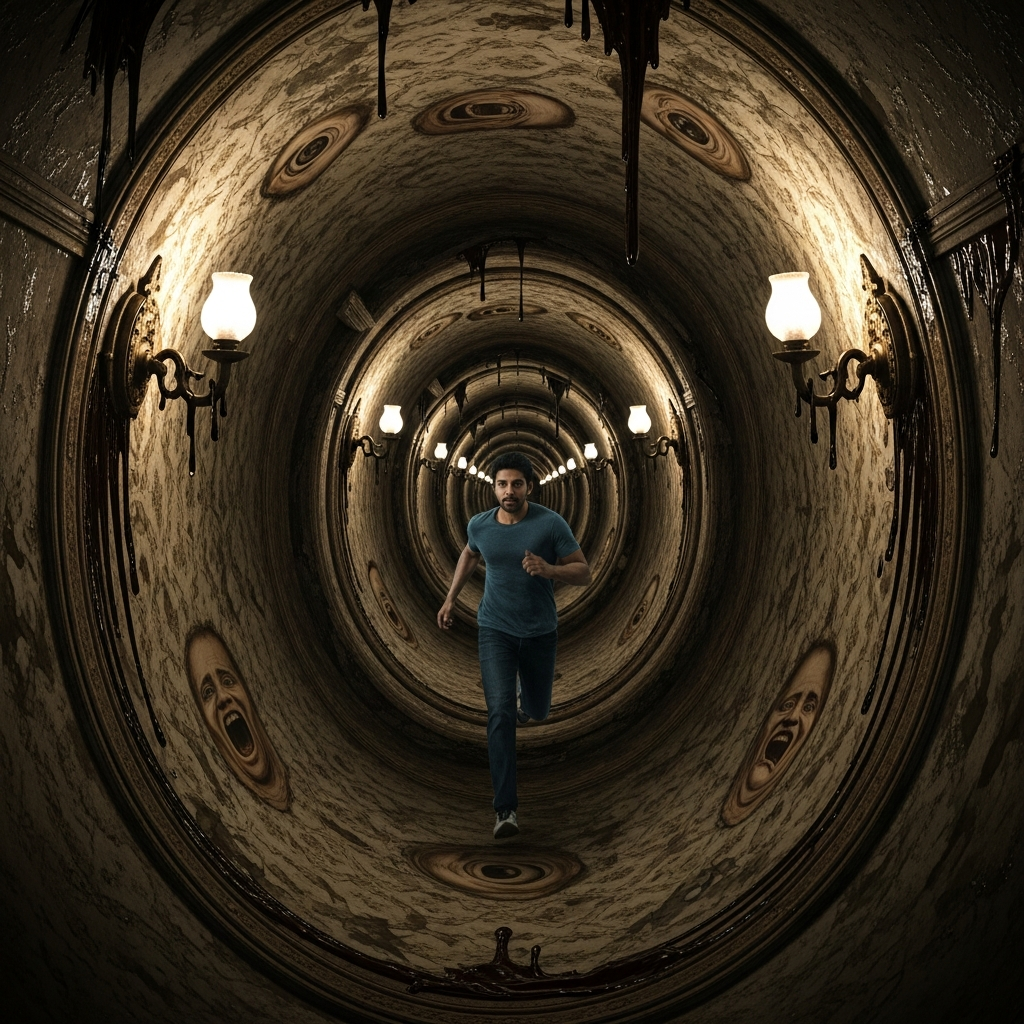
Seeking an exit, Adesh Ingale turned back toward the foyer, but the door was gone. In its place stood a corridor that stretched into an impossible perspective, lit by flickering sconces that bled black oil. He ran, his footsteps echoing with a delay that suggested the house was struggling to keep up with his movement. Each door he passed opened into a room that defied logic: a bedroom where the ceiling was a churning ocean of dark water; a dining hall where the chairs were made of frozen smoke. He stopped, gasping for breath, and leaned against a wall. The wallpaper felt like damp skin. To his horror, the pattern of the paper began to change, the floral motifs twisting into the shape of his own face, screaming in silent agony. Adesh felt a phantom pain in his chest, a sensation of his internal organs being rearranged. He pulled out his wallet to find his ID, but the plastic was blank. His name, his face, his signature—all gone. He was becoming a ‘no-thing,’ a variable deleted from the world’s equation. The house groaned, a deep, tectonic sound that vibrated through his teeth. It was the sound of a massive mind trying to solve a puzzle, and Adesh was the piece that didn’t fit. He looked at his reflection in a passing mirror and saw a blur of static where his features should be. He was losing the war of identity. The architecture was a labyrinth of amnesia, designed to strip a soul bare until nothing remained but the architecture itself. He had to find the core of the house, the cellar of his consciousness, before the erasure became absolute.
Scene 4
The Mimic in the Cellar
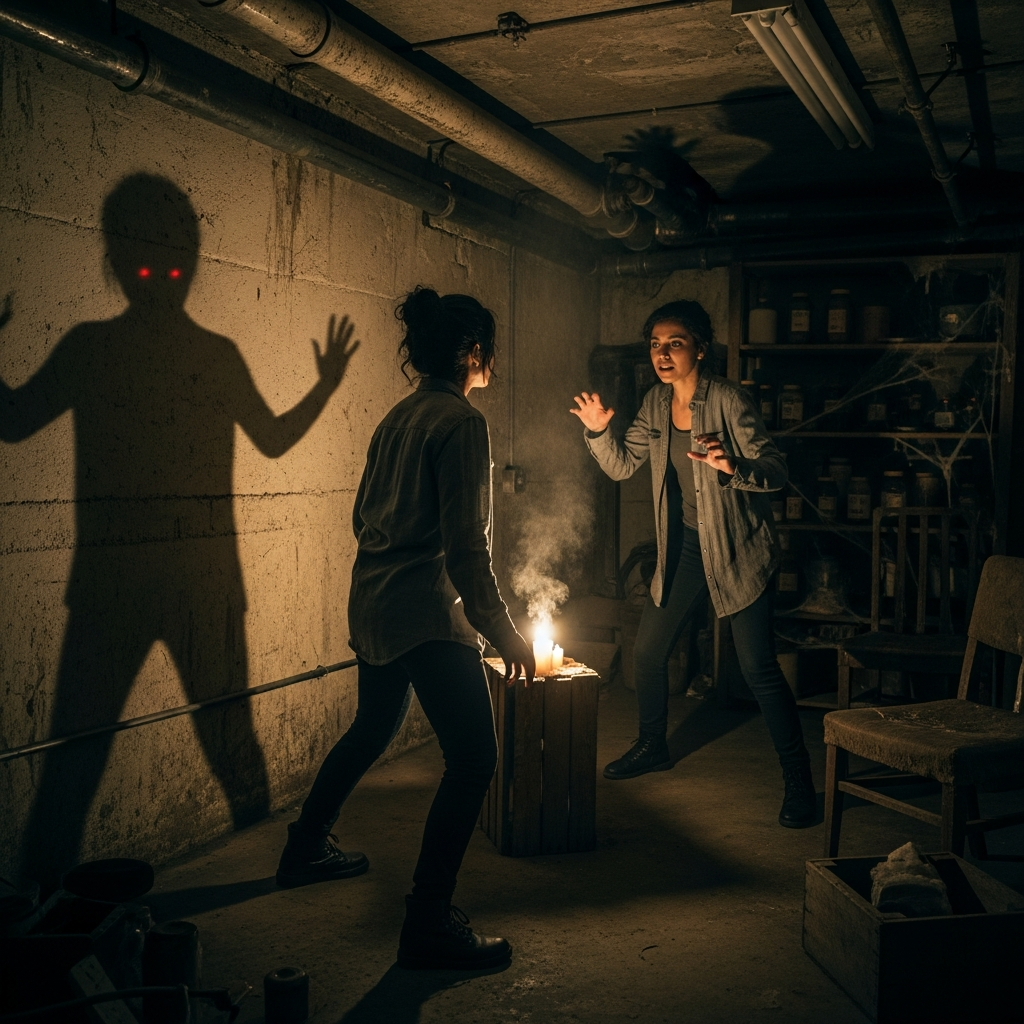
The descent into the basement felt like falling down a throat. Adesh Ingale clutched the banister, which felt increasingly like a row of vertebrae. The air here was freezing, smelling of ancient ice and ozone. As he reached the bottom step, the silence was broken by the sound of a pen scratching on parchment. In the center of the vast, cavernous basement sat a desk lit by a single, dying candle. A figure was hunched over it, writing frantically. Adesh approached, his footsteps making no sound on the dirt floor. As he got closer, he saw the figure’s hands—they were identical to his own, right down to the small scar on the left thumb. The figure turned, and Adesh looked into his own eyes—but they were eyes that held no recognition, only a terrifying, vacant hunger. This was the House’s version of him, a construct made of the memories the building had stolen. ‘You are the shadow,’ the construct whispered, its voice a perfect mimicry of Adesh’s own baritone. ‘I am the record. I am the memory that remains.’ The House pulsed, the walls expanding and contracting like a giant lung. Adesh felt his physical form begin to fray at the edges, his sleeves dissolving into threads of smoke. The construct was becoming more solid, its skin gaining color as Adesh lost his. The air was filled with the whispers of everyone who had ever lived in the Malhar Estate, a cacophony of forgotten names and discarded lives. He realized then that he wasn’t the first victim; the house was a collection of stolen identities, a graveyard of personas rebuilt into a singular, malevolent entity.
Scene 5
The Paradox Weapon

Adesh Ingale lunged at the construct, his hands passing through the entity like cold fog. The ‘New Adesh’ laughed, a sound that echoed from the walls rather than its throat. ‘You cannot fight what you no longer own,’ it taunted. Adesh felt a wave of nausea. He realized that the House was using his own logic against him. It had taken his facts—his name, his face, his history—but it hadn’t taken his essence. He looked around the basement and saw the physical manifestations of his forgotten memories floating like embers in the air. He grabbed one—a memory of his mother’s voice—and felt a jolt of electricity. It was painful, but it was real. He began to gather these fragments, weaving them into a shield of pure, raw emotion. The House shrieked. The ceiling began to drip a thick, tar-like substance that burned where it touched. The construct tried to grab him, its fingers elongating into claws of shadow. Adesh realized that the only way to defeat the House was to feed it something it couldn’t digest: a paradox. He focused on the memory of the House itself—the way it felt to be forgotten. He projected that feeling of absence back into the walls. If the House forgot him, he would forget the House. The pillars began to crack. The construct’s face distorted, its features melting like wax near a flame. Adesh stood his ground, his form flickering between solid matter and ethereal light. He was no longer just a man; he was a focal point of a metaphysical storm, a battle between a sentient space and a stubborn soul.
Scene 6
The Great Unmaking
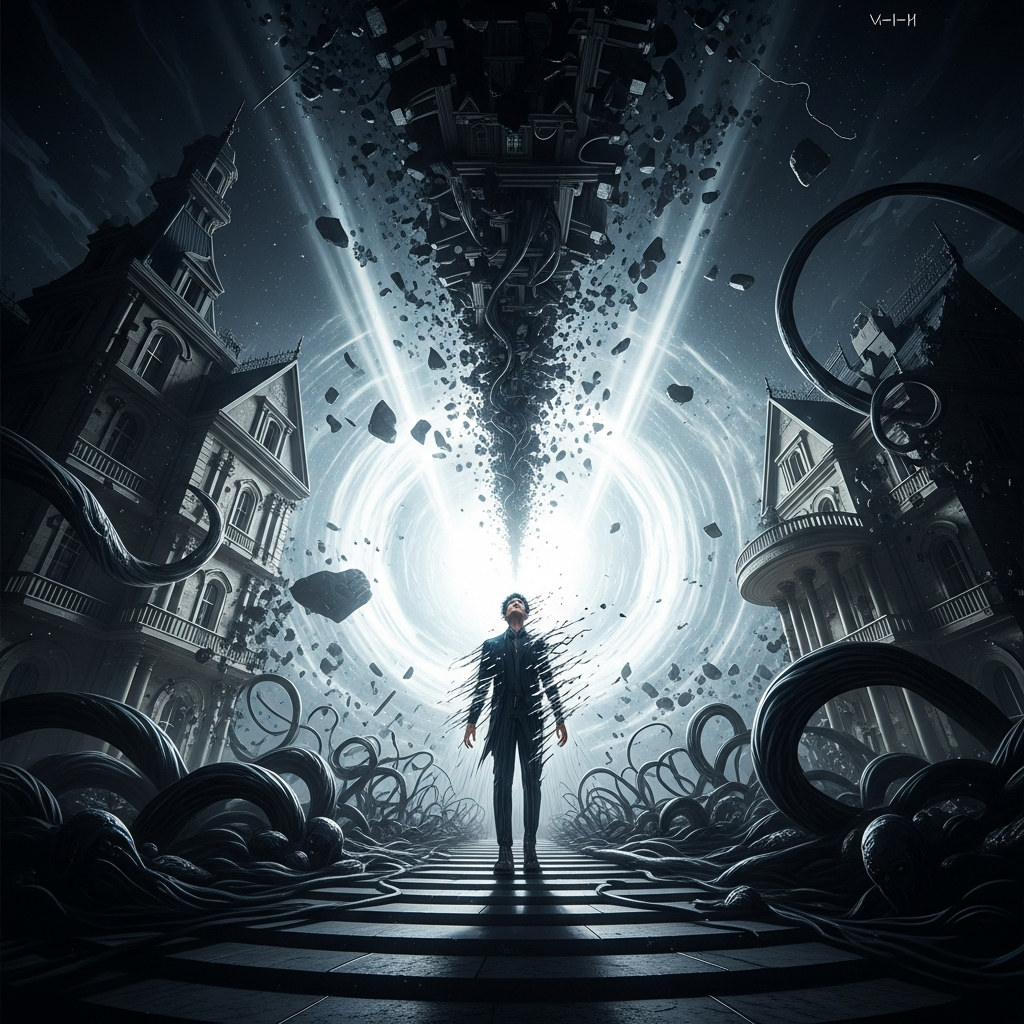
The climax was not a roar, but a devastating silence that shattered the windows of the Malhar Estate. Adesh Ingale stood in the center of the basement as the reality around him fractured. The construct of himself dissolved into a puddle of ink, which the floor greedily drank. The house began to fold in on itself, the dimensions collapsing like a cardboard box. Adesh felt his body being stretched across time and space. He saw the history of the estate in a frantic blur: the laying of the first stone, the deaths of its inhabitants, the slow growth of its hunger. He realized the House was a lonely god, trying to understand humanity by consuming it. He didn’t fight the erasure anymore; he embraced it, allowing his consciousness to expand into the very wood and stone. He became the house for a fleeting second, feeling the coldness of the plumbing and the weight of the roof. In that moment of total Union, he found the ‘delete’ key. He didn’t just reclaim his memories; he reprogrammed the House’s core logic. He forced it to remember everything it had ever erased—every servant, every child, every ancestor. The weight of all those forgotten lives was too much for the structure to bear. The walls buckled under the pressure of ten thousand reclaimed identities. The ground beneath Adesh opened up, a vortex of light and sound that threatened to swallow his very soul. He screamed one last time, a defiant declaration of his own existence, and felt himself being propelled upward through the churning layers of history and architectural spite.
Scene 7
The Morning of the Self

Adesh Ingale woke up face-down in a field of tall, golden grass. The sun was rising, casting a warm, honey-colored light across the landscape. He sat up, gasping for air, his lungs burning as if he had been underwater for hours. He looked at his hands—they were solid, tanned, and distinctly his own. He felt his face, tracing the lines of his jaw and the bridge of his nose. He was whole. He turned around to look for the Malhar Estate, but there was nothing there. No ruins, no foundation, not even a single brick remained. In its place stood an ancient banyan tree, its roots deep and wide, its leaves whispering in the gentle morning breeze. The House that Forgot Him was gone, purged by the weight of its own stolen memories. Adesh reached into his pocket and found his wallet. His ID was there, his face smiling back at him from the plastic card. His wedding ring was heavy on his finger. He stood up, feeling a profound sense of lightness, as if he had shed a skin he never knew he was wearing. He walked toward the road, his footsteps now firm and resonant on the earth. He didn’t look back. He knew that the House hadn’t just forgotten him; he had finally forgotten the House, and in doing so, he had truly found himself. The surreal horror was over, replaced by the simple, terrifying beauty of a life that was once again his own to write. Adesh Ingale breathed in the scent of wild jasmine and began the long walk home to a world that finally knew his name.